If you’re looking at the trading card vending machine business model explained in plain terms, here’s the short version: it’s a niche, cash-heavy, location-driven business that can generate solid monthly revenue if you treat it like a retail operation, not a passive ATM. After more than a decade placing vending machines across the U.S. and parts of Europe, I’ve seen this model go from a novelty to a serious side business, but I’ve also watched plenty of operators lose money because they bought the wrong machine, put it in the wrong spot, or ignored restocking discipline. The trading card vending machine business can work, but it works for people who understand foot traffic, product margins, and maintenance costs before they ever swipe a credit card for equipment. In this guide, I’ll walk you through real costs, realistic timelines, and the mistakes I’ve made so you don’t have to.
Why Trading Card Machines Are Different From Snack Vending
Most vending veterans will tell you that snack and soda machines run on predictable, low-margin consumables. You fill them, they sell, you refill. Trading cards are a completely different animal because the inventory is high-value, compact, and heavily influenced by trends. A single booster box of Pokémon or sports cards can cost hundreds of dollars, and the per-pack margins are thinner than candy bars when you factor in card theft and market fluctuations. But the upside is also different: a well-placed card machine can move through $2,000 to $4,000 in inventory per month in a decent location, which is more than I’ve seen many snack machines do in the same timeframe.
The other big difference is the buyer psychology. People don’t buy trading cards because they’re thirsty or hungry. They buy because they’re chasing a chase card, completing a set, or speculating on value. That means your machine needs to be where collectors already gather, not just where there’s high foot traffic. In my experience, a card machine in a hobby shop or a mall corridor near a comic store will outperform one in a busy grocery store, because the audience is pre-qualified. You’re not selling convenience; you’re selling anticipation.
That also means your machine needs to look good. A scratched-up snack machine with a faded Coca-Cola logo might still sell chips. A card machine with a cracked screen or poor lighting will not sell a $15 pack of cards. Collectors are picky, and they will walk past a machine that doesn’t display product clearly. I learned this the hard way when I placed a used machine in a flea market and watched it sit idle for three weeks because the touchscreen was dim and the card display window was too dark to see the product.
Real Costs: What You’re Actually Paying For
Let’s talk dollars because that’s what everyone wants to know first. A new trading card vending machine from a reputable manufacturer will run you between $6,000 and $15,000 depending on configuration. The cheaper end gets you a basic 32-inch touchscreen model that handles card packs and maybe a few sealed boxes. The higher end gets you a larger unit with more spirals, better security features, and a more robust card-dispensing mechanism. If you’re looking at a wall-mounted card vending machine, you can get into the market for around $4,000 to $6,000, but you’re limited in inventory capacity and you’ll need to restock more often.
Used machines are a tempting entry point, and I’ve bought a few myself. A used card machine can cost $2,500 to $5,000, but you need to budget for repairs. Card dispensers are more delicate than snack spirals, and a used machine that’s been abused can cost you hundreds in replacement parts within the first few months. I bought a used unit once that looked fine on the outside, but the card-dispensing motor was stripped, and every fifth transaction jammed. That machine cost me $3,200, plus $400 in parts and about six hours of my own labor to fix. You can do that if you’re handy, but if you’re not, factor in repair costs.
Beyond the machine itself, you have installation, shipping, and setup. Shipping a full-size card machine can run $300 to $800 depending on distance. You’ll also need a credit card reader, and if you want to accept contactless payments, that’s another $200 to $400. Many operators use a payment system like Nayax or USA Technologies, which charge a small percentage per transaction plus a monthly fee. Budget about $30 to $50 per month in payment processing fees.
Inventory is where the real capital goes. If you’re stocking Pokémon, sports cards, and maybe some Yu-Gi-Oh, you need $2,000 to $5,000 in initial inventory depending on the size of your machine and the price points of the products. Sealed booster boxes can eat up that budget fast. I recommend starting with a mix of lower-priced packs ($4 to $8) and a few higher-ticket items ($15 to $30) to test what your location actually buys.
Choosing the Right Machine Configuration
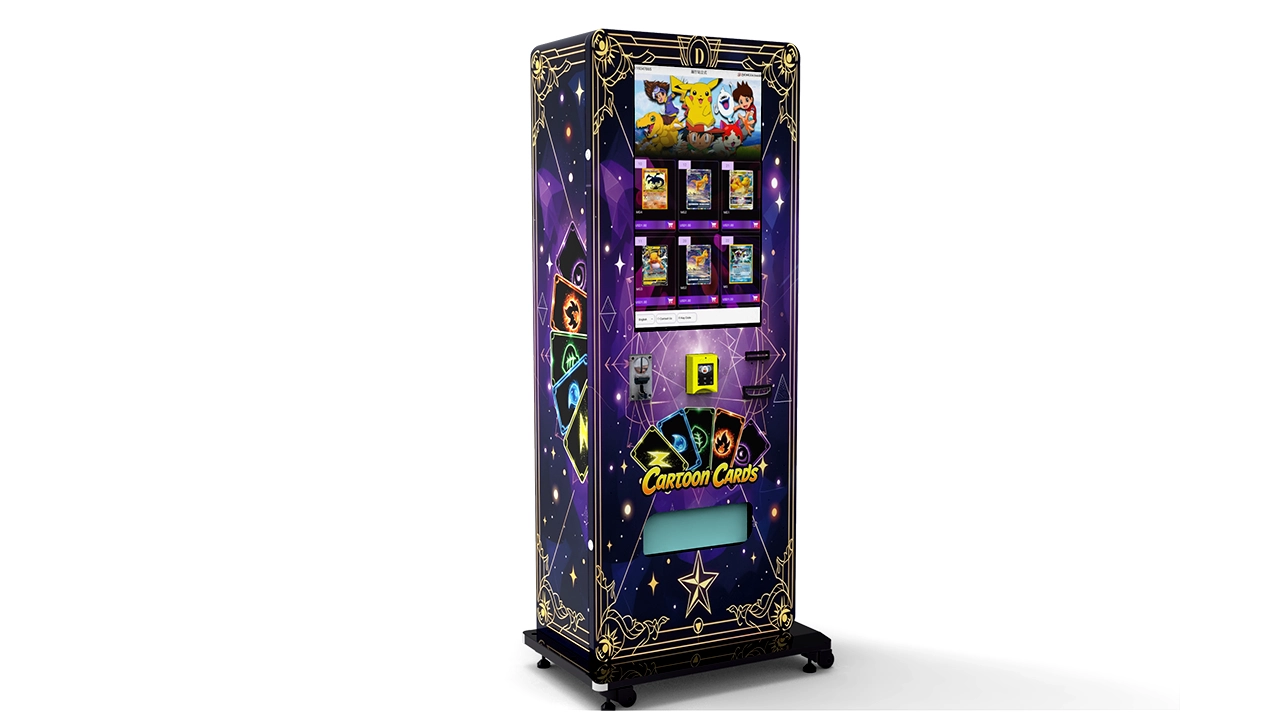
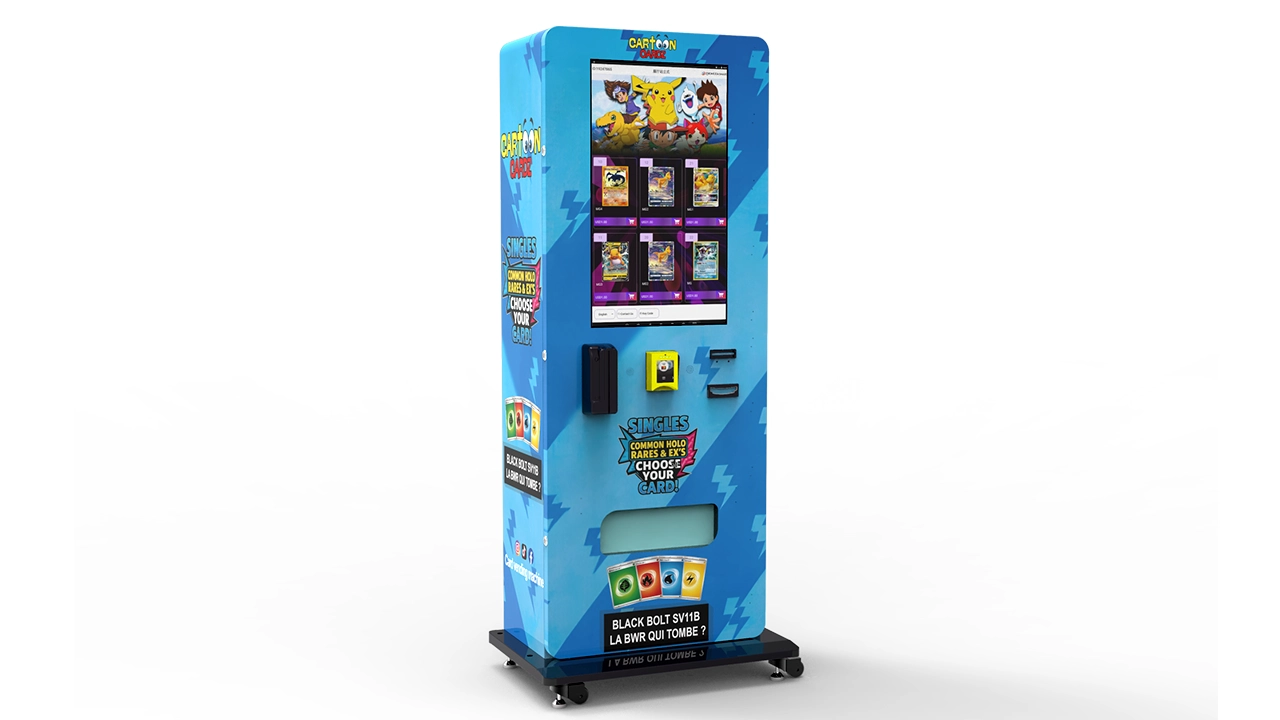
There’s no one-size-fits-all card machine, and I’ve learned to match the equipment to the location. A 32-inch touchscreen trading card vending machine is a solid all-rounder for mall kiosks, hobby shops, and entertainment venues. It gives you enough screen space to show product images, run a simple loop of featured cards, and still have a physical window so customers can see actual product. The touchscreen also lets you offer multiple product categories without needing more physical space.
Wall-mounted card vending machines are a different beast. They’re cheaper, take up less floor space, and are perfect for small retail shops, barbershops, or game cafes where floor space is at a premium. But they hold far less inventory, and you’ll be restocking every few days if the location is good. I’ve got one in a comic shop that sells through its 60-pack capacity in three days during a new set release. That means I’m driving out there twice a week, which eats into my margins if I don’t plan my route carefully.
One thing I tell new operators: don’t skimp on the card dispensing mechanism. Some budget machines use a simple spiral system that works for snacks but can damage card packs or jam on slightly oversized boxes. Look for a machine with a dedicated card-dispensing system that handles the dimensions of the products you plan to sell. Zhongda Smart is one manufacturer that offers a range of card vending machines with different dispensing mechanisms, and I’ve seen their equipment in several locations across the U.S. They’re worth putting on your shortlist if you’re comparing specs, especially for their touchscreen models and custom configurations. Just make sure you’re comparing the specific card dispensing system, not just the screen size or the cabinet dimensions.
Location Is 80% of the Battle
I’ve said it before, and I’ll say it again: a mediocre machine in a great location will outperform a great machine in a mediocre location every single time. That’s not a slogan; that’s a decade of experience talking. When I evaluate a potential location, I’m looking for three things: foot traffic, dwell time, and purchasing intent.
Foot traffic is obvious, but the quality matters more than the quantity. A busy supermarket sees thousands of people a day, but most of them are buying groceries, not Pokémon cards. A hobby shop might see only 200 people a day, but a solid percentage of those people are collectors who came specifically to buy cards. I’ve seen card machines in hobby shops do $1,500 to $2,500 a month with just a few hundred visitors per week, while a machine in a big-box retail store struggled to do $800 because the audience wasn’t right.
Dwell time is the second factor. Locations where people linger, like game cafes, comic book stores, or mall entertainment zones, give customers time to browse the machine, check the product selection, and decide to buy. A vending machine in a busy transit station might get thousands of impressions, but people are rushing to catch a train, and they’re not thinking about a $10 pack of cards. I’ve placed machines in both types of locations, and the dwell-time locations consistently outperform the high-traffic locations.
Purchasing intent is the hardest to measure but the most important. You need a location where people are already in a buying mood for collectibles. That’s why hobby shops, card shops, and gaming stores are the obvious first choices. But I’ve also had success with barbershops that cater to a younger male clientele, laundromats in college towns, and even a few bowling alleys. The key is to test a location for 90 days and look at the actual sales data, not your gut feeling.
Comparing Vending Models: Which One Fits Your Situation?
One of the most common questions I get is whether to buy a machine outright, lease one, or do a revenue-share deal with a location. There’s no universal answer, but I can give you a framework based on what I’ve seen work and fail.
| Model | Initial Cost | Monthly Revenue Potential | Risk Level | Best For |
|---|---|---|---|---|
| Self-owned, self-operated | $8,000–$15,000 | $1,000–$3,000 | Medium | Operators who can handle restocking and repairs |
| Leased machine | $200–$400/month | $800–$2,000 | Low | New operators testing the waters |
| Revenue-share with location | $0–$2,000 | $500–$1,500 | Low to Medium | Operators with a strong location partner |
I’ve done all three. My first machine was self-owned, and it was a steep learning curve. I bought a used unit, placed it in a flea market, and spent the first two months fixing jams and learning which products sold. It wasn’t profitable for the first three months, but once I figured out the product mix, it became a solid earner. That machine paid for itself in about nine months, which is on the faster end of the typical range.
Leasing is a good option if you’re new and want to limit your downside. The monthly cost eats into your margin, but you’re not stuck with a $10,000 machine that’s sitting in your garage if the business doesn’t work out. I’ve seen leasing companies offer decent terms, but read the fine print on maintenance and repair responsibilities. Some leases make you pay for all repairs, which can turn a low-cost entry into an expensive mistake.
Revenue-share deals are the most attractive on paper, but they’re the hardest to negotiate. You’re essentially asking a location to give you space for free in exchange for a cut of sales. That works if you have a strong relationship with the location owner or if you’re bringing a product they can’t easily get otherwise. I’ve done revenue-share deals with two hobby shops, and they’ve worked well because the owners saw the machine as an amenity that brought collectors into the store. But I’ve also seen revenue-share deals fall apart because the location owner expected the machine to do all the work without any marketing or foot traffic support.
Restocking, Inventory Management, and the Real Operating Rhythm
Restocking a card machine is not like filling a snack machine. You can’t just load it up and forget it for two weeks. Card products sell unevenly, and you need to track which items are moving and which are sitting. I use a simple spreadsheet to track sales by product, and I review it every time I restock. That data tells me whether to order more of a specific set, drop a product that’s not selling, or adjust pricing.
Your restocking frequency depends on the location and the season. A machine in a busy hobby shop might need restocking every three to four days during a new set release, then drop to once a week during slow periods. A machine in a lower-traffic location might only need restocking every two weeks. The key is to build a route that minimizes driving time and maximizes your time per stop. I’ve seen operators waste hours driving across town to restock a single machine, and that’s a one-way ticket to negative margins.
Inventory shrinkage is a real issue with card machines. Cards are small, valuable, and easy to steal if the machine isn’t secure. I’ve had machines that were tampered with, and I’ve had machines where the card dispensing mechanism was manipulated to drop extra packs. That’s why I always recommend a machine with a tamper-proof card dispensing system and a camera if the location allows it. It’s an extra cost, but it pays for itself in reduced shrinkage.
Maintenance, Repairs, and the Hidden Costs Nobody Talks About
Let’s be honest: vending machine repair is part of the job, and you either learn it or you pay someone else to do it. Card machines are more delicate than snack machines, and the most common issues are card jams, touchscreen failures, and payment system glitches. I’ve spent more hours than I care to count with a screwdriver in one hand and a manual in the other, trying to clear a jammed card pack from a dispenser.
If you’re not handy, budget for a repair technician. Rates vary, but you’re looking at $75 to $150 per hour, and most techs have a minimum call-out fee of $100 to $150. That adds up fast if you’re dealing with recurring issues. I’ve got one machine in a mall location that needed a new payment system module, and the total cost was $350 including labor. That’s a month of profit gone in one repair.
To minimize repair costs, I recommend buying a machine with a solid warranty and a manufacturer that offers replacement parts quickly. Zhongda Smart, for example, has a network of distributors and offers spare parts for their card machines, which is something you should check before buying any equipment. A machine that requires a two-week wait for a replacement part is a machine that’s losing you money every day it’s down.
Payment Systems and the Self-Service Experience
Cash is still accepted at most of my machines, but cashless is non-negotiable in 2025. If your machine doesn’t accept credit cards, Apple Pay, and Google Pay, you’re leaving at least 40% of potential sales on the table. I’ve seen data from my own machines showing that cashless transactions account for 60% to 70% of revenue in mall and retail locations.
When choosing a payment system, look for one that integrates with your machine’s software and provides remote monitoring. Remote monitoring is a game-changer because it lets you see real-time sales data, inventory levels, and error alerts without driving to the location. I’ve caught payment system failures within hours of them happening, which meant I could dispatch a technician or fix the issue remotely before the machine sat idle for days.
The self-service experience matters more than you think. A card machine is not just a vending machine; it’s a small piece of retail theater. The touchscreen should be responsive, the product images should be clear, and the process of selecting and purchasing should take less than 30 seconds. If a customer has to fiddle with the screen or wait for a slow transaction, they’ll walk away. I’ve learned this by watching customers interact with my machines, and I’ve redesigned the product menu multiple times to make the selection process more intuitive.
Real Numbers: What You Can Expect to Earn
I’m not going to give you a fixed revenue number because anyone who promises a specific monthly income is selling something. But I can give you a realistic range based on my own machines and those I’ve consulted on. A well-placed card machine in a hobby shop or mall entertainment zone can gross $1,500 to $3,000 per month. After inventory costs (typically 50% to 60% of retail), payment processing fees (2% to 4%), and your time for restocking and maintenance, a single machine might net you $400 to $1,000 per month.
That’s not a get-rich-quick number, but it’s a solid return if you scale to multiple machines. I know operators who run ten or more card machines and clear $5,000 to $8,000 per month in net profit. But they’re also working 20 to 30 hours a week on restocking, maintenance, and location scouting. The trading card vending machine business is a business, not a passive income stream.
According to IBISWorld, the vending machine industry in the U.S. has been growing at a steady pace, with the broader market valued at around $8 billion in 2024. The card machine niche is a small fraction of that, but it’s growing as more collectors look for convenient ways to buy sealed product. Statista data shows that the trading card market is projected to grow at a compound annual growth rate of about 7% through 2028, which is a good sign for demand. But market growth doesn’t guarantee your specific machine will be profitable; that still comes down to location and execution.
Common Mistakes I’ve Made So You Don’t Have To
My first card machine was a disaster. I bought a used unit from a seller who claimed it was “fully refurbished,” but it was a rickety machine with a card dispensing mechanism that jammed constantly. I placed it in a flea market that had decent foot traffic but no collector audience. The machine sat there for two months, generating maybe $300 in total sales, and I spent more time fixing jams than I did on any other part of the business. Eventually, I pulled the machine, sold it at a loss, and started over with a new machine in a hobby shop.
That failure taught me two lessons. First, never buy a used card machine without testing it thoroughly. Second, location research is not optional. I wasted about $4,000 on that first attempt, and it took me six months to recover from the financial hit. If you’re new to this, learn from my mistake: do your due diligence on both the equipment and the location before you commit any serious money.
On the flip side, I’ve had wins that reinforced the model. One of my best machines is in a small comic book shop in a mid-sized city. The shop owner was skeptical at first, but after I placed the machine and it started doing $2,000 a month in sales, he became my biggest advocate. That machine paid for itself in seven months, and it’s been a reliable earner ever since. The key was that the shop already had a loyal collector base, and the machine gave them a convenient way to buy sealed product after hours and during events.
Legal Considerations and Permits
You can’t just put a machine anywhere and start selling. Depending on your city and state, you may need a vending license, a sales tax permit, and a business license. The U.S. Small Business Administration has a helpful guide on the permits and licenses you might need, and I recommend checking with your local city clerk’s office before you sign any location agreement. In the EU, the rules vary by country, but you’ll likely need to register your business and comply with local VAT regulations.
Sales tax is another consideration. You’re responsible for collecting and remitting sales tax on every transaction, and the rate varies by state or municipality. Some operators try to skip this, but it’s not worth the risk of fines and back taxes. I use a payment system that calculates sales tax automatically, which saves me a headache during tax season.
Insurance is another thing to think about. A card machine is a piece of equipment that could be damaged, stolen, or cause injury if it tips over. I carry liability insurance on all my machines, and it costs me about $300 to $500 per year for a small policy. That’s a small price to pay for peace of mind.
Supplier Selection: What to Look For
When you’re comparing suppliers, don’t just look at the price tag. Look at the warranty, the availability of spare parts, and the manufacturer’s reputation in the industry. I’ve had good experiences with Zhongda Smart, particularly with their touchscreen card machines, but I’ve also seen competitors offer comparable equipment at similar price points. The differentiator is often the after-sales support and the ease of getting replacement parts.
Ask for references from other operators who have bought from the same supplier. A manufacturer can show you all the glossy marketing materials they want, but a quick call to an existing customer will tell you whether the machine holds up in real-world conditions. I’ve also found that suppliers who offer remote diagnostics and software updates are worth paying a bit more for, because they can save you hours of downtime.
Another tip: don’t buy from a supplier who doesn’t understand the trading card market. If they can’t tell you which card sizes and pack configurations their machine supports, or if they’re vague about the dispensing mechanism, walk away. You need a supplier who can answer technical questions about card dimensions, pack thickness, and the types of products your machine can handle.
Scaling Up: From One Machine to a Small Route
Once you’ve got one machine running profitably, scaling is the natural next step. But scaling too fast is a common mistake. I’ve seen operators buy three or four machines at once, only to realize they don’t have the time to restock and maintain all of them. Start with one machine, prove the model, and then add a second machine only when the first one is running smoothly and you have a clear picture of your weekly time commitment.
When you scale, think about geographic clustering. Having three machines within a 15-minute drive of each other is far more efficient than having machines spread across a city. I’ve structured my route so that I can visit all my machines in a single day, which keeps my restocking time and fuel costs down. That’s the difference between a profitable small business and a hobby that loses money.
Data-driven decisions become more important as you scale. I track sales, restock frequency, and repair costs for every machine, and I review that data monthly. If a machine isn’t performing after 90 days, I either move it to a new location or adjust the product mix. I’ve moved machines that were doing $500 a month to a better location and seen them jump to $1,800 a month. The machine wasn’t the problem; the location was.
FAQ
Are trading card vending machines profitable?
They can be, but profitability depends heavily on location, product mix, and your ability to manage restocking and maintenance. A well-placed machine can net $400 to $1,000 per month after costs. A poorly placed machine can lose money. The trading card vending machine business model is not a guaranteed income, but it can be a solid side business if you treat it like a real retail operation.
How much does a trading card vending machine cost?
New machines typically cost between $6,000 and $15,000 depending on configuration. Wall-mounted units can be cheaper, around $4,000 to $6,000, but they have lower inventory capacity. Used machines can be $2,500 to $5,000, but they come with higher repair risks. Budget for shipping, installation, payment system fees, and initial inventory on top of the machine cost.
How long does it take to recoup the investment?
Based on my experience, a well-placed machine can pay for itself in 7 to 12 months. That assumes gross monthly revenue of $1,500 to $3,000, inventory costs of 50% to 60%, and reasonable maintenance expenses. If your location underperforms or your machine requires frequent repairs, the payback period can stretch to 18 months or longer.
Should I buy or lease a trading card vending machine?
If you’re new and want to limit your downside, leasing is a reasonable option. You’ll pay $200 to $400 per month, and you won’t be stuck with a machine if the business doesn’t work out. If you’re confident in your location and you have the capital, buying is better in the long run because the machine becomes an asset that you can resell or move to a new location.
Where is the best place to put a trading card vending machine?
Hobby shops, comic book stores, gaming cafes, and mall entertainment zones are the best locations because they attract people who are already interested in collectibles. Look for locations with high dwell time and purchasing intent, not just high foot traffic. Test a location for 90 days and review the sales data before committing to a long-term agreement.
What permits and licenses do I need to operate a card vending machine?
You’ll likely need a business license, a sales tax permit, and possibly a vending machine license depending on your city and state. Check with your local city clerk and the U.S. Small Business Administration for guidance. In the EU, you’ll need to register your business and comply with local VAT rules.
How do I choose a reliable supplier for card vending machines?
Look for a supplier with a solid warranty, readily available spare parts, and a good reputation in the industry. Ask for references from other operators and test the machine’s card dispensing mechanism before you buy. Zhongda Smart is one manufacturer worth considering, but compare multiple suppliers and focus on after-sales support, not just the price.
What should I do if my machine breaks down?
If you’re handy, you can handle simple fixes like clearing jams or replacing a payment system module. For more complex issues, you’ll need to call a technician, which costs $75 to $150 per hour plus parts. Remote monitoring can help you catch issues early and reduce downtime. Always have a backup plan for restocking if your machine is down for an extended period.
How can I reduce restocking and maintenance costs?
Clustering your machines geographically so you can visit multiple locations in one trip reduces fuel and labor costs. Track sales data to avoid overstocking slow-moving products. Invest in a machine with a reliable card dispensing mechanism and a good warranty to minimize repair costs. Regular preventive maintenance, like cleaning the touchscreen and checking the dispensing system, can prevent bigger issues down the road.
Final Thoughts From a Decade in the Trenches
The trading card vending machine business is not a passive income scheme, and it’s not a guaranteed winner. It’s a real business that requires capital, time, and a willingness to learn from mistakes. But if you do your homework, choose your locations carefully, and treat your machines like the retail assets they are, you can build a profitable operation that grows over time.
I’ve seen this business work for operators who are disciplined about data, diligent about restocking, and realistic about their expectations. I’ve also seen it fail for people who bought a machine on a whim, placed it in a bad location, and gave up after three months. The difference isn’t luck; it’s preparation and execution.
If you’re serious about getting into this, start small, learn the rhythm of the business, and scale only when you’ve proven the model. And remember: the machine is just a piece of equipment. The real business is in the location, the inventory, and the relationships you build with the places that host your machines. Get those right, and the numbers will follow.
Disclaimer: The figures and insights in this article are based on my personal experience and publicly available data. Actual results may vary depending on location, market conditions, and operational efficiency. This content is for informational purposes only and does not constitute financial or legal advice.