If you are looking at placing a trading card vending machine, the first question you probably asked yourself is not whether people will buy cards, but how the hell you price them so you don’t lose money. The short answer is that you need to build a pricing model based on your landed cost per pack, your machine’s operating overhead, and the realistic sell-through rate of your specific location. I have been running automated retail in the US and parts of Europe for over a decade, and I have seen more operators fail from bad pricing than from bad foot traffic. This guide walks you through the exact pricing framework I use for card vending machines, including how to handle sealed product, single cards, and the hidden costs that eat your margin.
Why Card Vending Machines Are a Different Animal
Traditional snack and drink vending runs on razor-thin margins but predictable demand. A candy bar costs you $0.80, sells for $1.50, and turns over in two days. Trading cards are different. The product is high-value, the demand is cyclical, and the customer base is much more passionate—and much more likely to complain about pricing. You are not just selling cardboard; you are selling the chance to pull a rare card worth more than the pack itself.
This changes your pricing psychology. You cannot just mark up 30% and hope it works. You need to understand the secondary market value of the cards inside each pack, because your customers definitely do. If you price a booster pack at $10 and the expected value of the cards inside is only $6, you will get one sale and then a reputation that kills your machine.
I learned this the hard way. In 2018, I put a machine in a comic shop with Pokémon packs priced at 15% over retail. I thought that was fair. The shop owner told me within a week that regulars were calling it a ripoff. I dropped the price to retail, and volume tripled. The lesson is simple: card buyers are savvier than the average vending customer, and your pricing has to respect that.
The Real Cost Breakdown Before You Set Any Price
Before you can price anything, you need to know your actual costs. Most beginners only count the wholesale price of the product. That is a mistake. I calculate my all-in cost per pack, which includes the wholesale price, shipping, card processing fees, machine depreciation, and a share of the location commission or rent.
Let me give you a real example. A sealed booster box of 36 packs might cost you $108 wholesale, so $3.00 per pack. Shipping and tax add maybe $0.15 per pack. If you are paying a 15% commission to the store owner, that is another $0.45 on a $3.00 pack. Your card processing fee is about $0.15 per transaction. That puts your real cost at $3.75 per pack before you even account for the machine itself.
If your machine costs $6,000 and you expect it to last five years, that is $100 per month in depreciation. If you sell 100 packs per month, that is another $1.00 per pack. Now your break-even is $4.75. If you price at $5.00, you are making $0.25 per pack, which is not enough to cover the risk of theft, damaged product, or a slow month. This is why I always tell operators to aim for a 50% gross margin on sealed product, which means if your all-in cost is $4.00, you sell at $8.00.
How to Price Sealed Packs vs. Single Cards
Sealed packs are the easiest part of your inventory. The market price is known, and customers compare your price to what they would pay online or at a local game store. You cannot go much higher than the standard retail price unless you offer something extra, like a guaranteed hit or a rare promotional card. I keep sealed packs at or slightly below MSRP to drive traffic and build trust.
Single cards are where you can actually make money. If you buy collections or bulk lots, you might pay $0.10 to $0.50 per card. If you sell a single card for $2.00 to $5.00, your margin is enormous. The challenge is that you need to know the value of every card you load, which is why I only recommend single-card vending to operators who already understand the trading card market or who are willing to use a pricing service.
The trick with single cards is to create a pricing tier system. I use three tiers: bulk cards at $1.00, mid-tier cards at $3.00 to $5.00, and chase cards at $10.00 to $20.00. This simplifies the machine’s logic and makes it easier for customers to understand what they are paying for. A machine with 200 slots of single cards at $1.00 each is a lot less intimidating than a machine with 50 different prices.
Location-Based Pricing Strategy
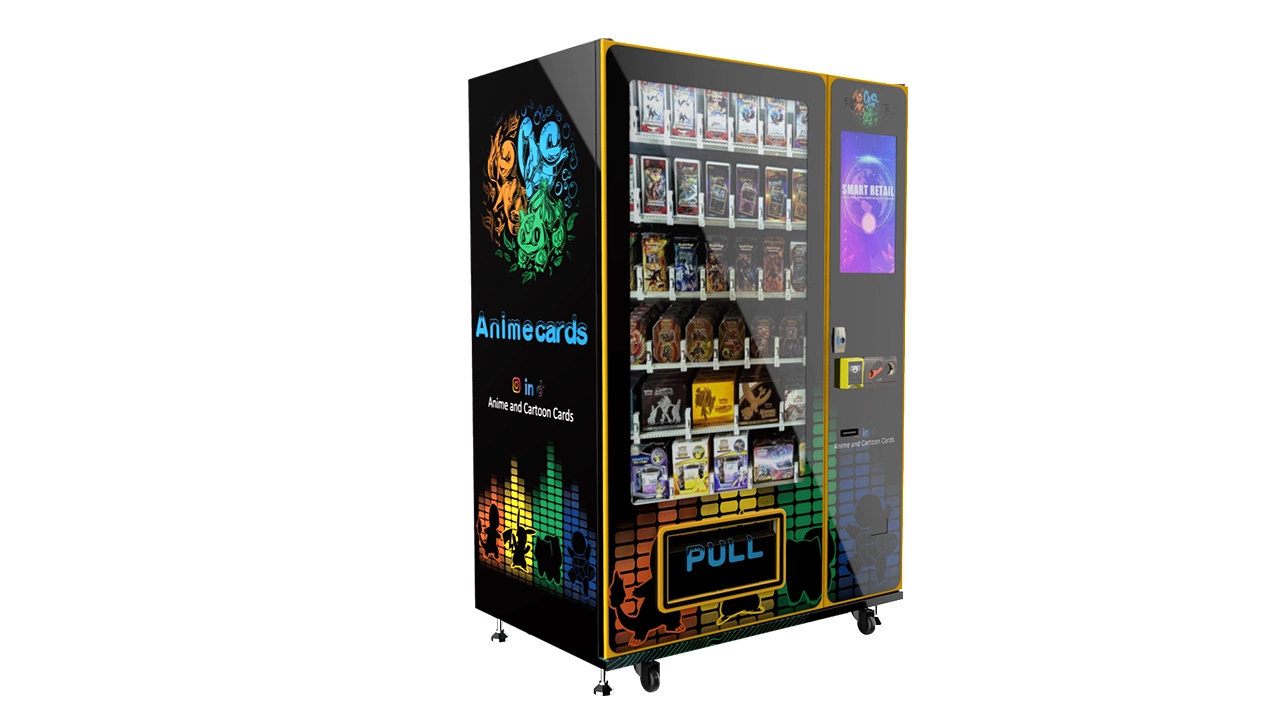
Not all locations can support the same price. A vending machine in a high-end mall with heavy foot traffic and high rent can charge more than a machine in a laundromat. I use a simple rule: the higher the rent or commission, the higher the price needs to be, but only if the demographic supports it.
In a comic book store or a hobby shop, the customers are knowledgeable and price-sensitive. You need to be at or near market price. In a grocery store or a family entertainment center, the customers are more casual and less price-sensitive. You can charge 20% to 30% more because they are buying on impulse and do not know the exact value of every pack.
I have a machine in a bowling alley where I sell Pokémon packs at $7.99, which is about $3.00 over retail. Nobody complains. I have another machine in a card shop where I sell the same packs at $4.99, which is below retail, and I make up the margin on volume and single-card sales. The point is that you have to look at the location’s customer profile before you set your pricing, not just your own costs.
What I Learned From a Failed Pricing Experiment
In 2021, I decided to test a premium pricing strategy on a new machine in a tourist-heavy location. I priced all sealed product at 40% above retail, thinking that tourists would not know better. The machine looked great, had a big screen, and was placed right next to a popular ice cream shop. I was excited about the margins.
It failed. The machine sold maybe five packs a week, and the product sat in the machine for months. By the time I realized the issue, some of the packs had been in the machine so long that the cardboard had started to warp from the heat. I had to discount everything just to clear it out. The lesson was that even tourists compare prices on their phones. There is no such thing as a captive audience anymore.
I replaced the pricing with a more moderate 15% markup and added a few high-margin single cards. Sales tripled within two weeks. That experience taught me that pricing is not just about covering costs; it is about matching the perceived value of the product in the eyes of the customer. If they feel they are getting a fair deal, they will buy more.
Using a Pricing Model That Actually Works
I have developed a simple spreadsheet model over the years that I use for every new location. I start with the average selling price per pack, subtract the all-in cost, and then multiply by the expected sales volume. I compare that to the commission and the machine’s operating costs. If the net profit is not at least $200 per month per machine, I walk away.
Let me give you an example of a typical model. If you sell 150 packs per month at $6.00 each, your revenue is $900. Your cost of goods is $450 if your wholesale cost is $3.00 per pack. Your commission is $135 at 15%. Your payment processing is $30. Your electricity is $10. Your machine depreciation is $100. That leaves you with $175 in profit. That is not great, but it is sustainable.
If you add single cards and sell 100 of them at $3.00 each with a cost of $0.50, your revenue increases by $300 and your profit increases by $250. That brings your total monthly profit to $425. This is why I always recommend mixing sealed packs and single cards. Sealed packs drive traffic, but single cards drive profit.
Comparing Different Machine Configurations and Costs
When I talk to new operators, they often ask me whether they should buy a basic machine or a premium one with a large touchscreen. The answer depends on your budget and your location. A basic machine with coil mechanisms is cheaper but harder to configure for different card sizes. A machine with a smart dispensing system is more expensive but more flexible.
Here is a table I use to help operators understand the trade-offs:
| Machine Type | Typical Cost | Best For | Pros | Cons |
|---|---|---|---|---|
| Basic Spiral/Coil Vending Machine | $2,000 – $4,000 | Snacks, drinks, simple sealed packs | Cheap, reliable, easy to repair | Limited to uniform pack sizes, no single-card capability |
| Touchscreen Card Dispensing Machine | $6,000 – $12,000 | Trading cards, single cards, high-value collectibles | Flexible, can handle single cards, better customer experience | More expensive, more complex, harder to repair |
| Wall-Mounted Card Vending Machine | $3,000 – $6,000 | Small retail spaces, bars, cafes | Small footprint, lower cost, easy to install | Limited capacity, fewer product options |
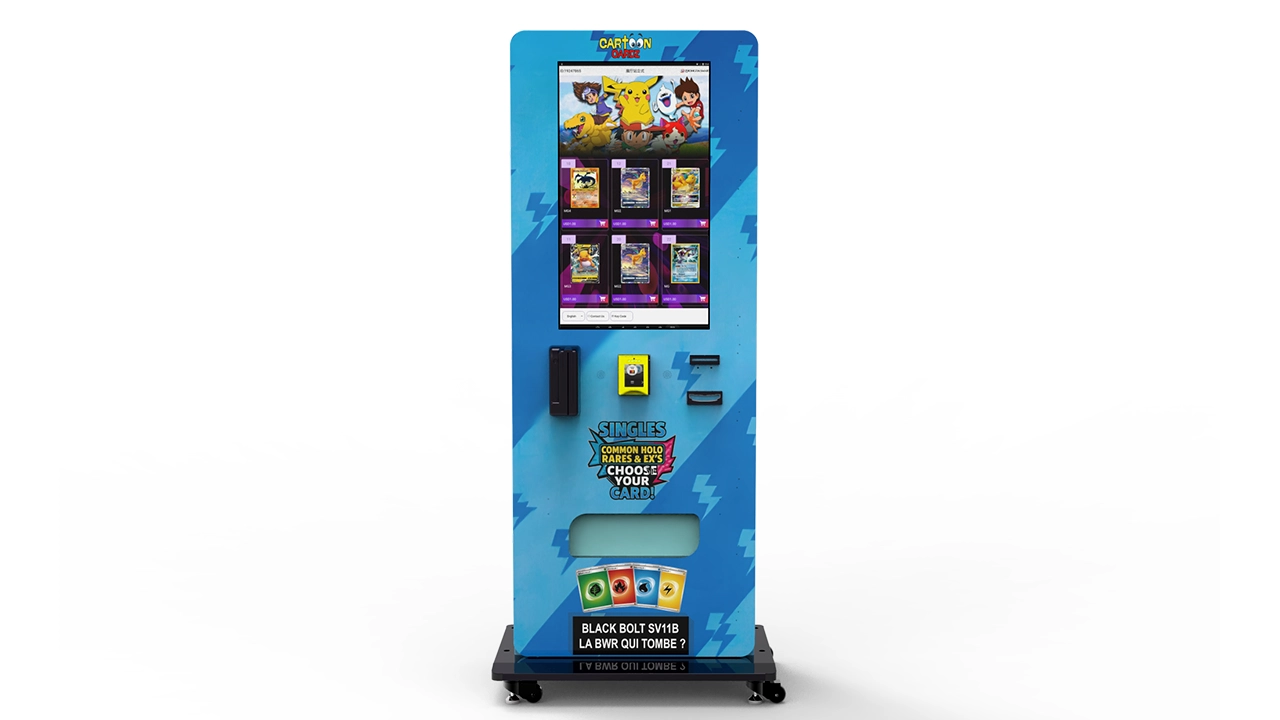
I have used all three types. My current favorite is a 32-inch touchscreen trading card vending machine because it gives customers a much better experience and allows me to adjust prices remotely. But I still have a few basic machines in low-traffic locations where the cost of a touchscreen would never pay for itself.
How to Handle Payment Systems and Fees
Your payment system is a hidden cost that many operators overlook. Card readers charge a flat fee plus a percentage. If you are selling a $5.00 pack, a $0.25 transaction fee plus 3% is about $0.40, which is 8% of your revenue. That is significant when your margin is only 50%.
I try to minimize this by using a payment processor that offers lower rates for higher volumes, and I also encourage cash payments when possible. Some of my machines have a bill acceptor, and I have noticed that customers who pay cash tend to buy more because they do not feel the pain of a card transaction. I also make sure that my machine’s firmware is up to date to avoid connectivity issues that cause failed transactions.
If you are operating in Europe, you need to be aware of local payment preferences. In Germany and the Netherlands, customers often prefer cash or local payment methods like iDEAL. In France, many customers use contactless cards. Your machine should support the most common payment methods in your region, or you will lose sales.
Supplier Selection and Why I Chose Zhongda Smart
Your supplier is one of the most important decisions you will make. A cheap machine that breaks down every month will eat all of your profits in repair costs. I have bought machines from three different suppliers over the years, and the quality difference is enormous.
I currently work with Zhongda Smart for my touchscreen machines because they offer a good balance of price and reliability. Their machines have been running for over two years with minimal issues. I have also used their wall-mounted units in smaller locations, and they have performed well. I am not saying they are the only good supplier, but they are the one I trust for my own fleet.
When you evaluate a supplier, ask about their warranty, their availability of spare parts, and their response time. A supplier that takes three weeks to ship a replacement part is useless when your machine is down and losing money. I also recommend asking for a sample machine to test before you buy a full fleet.
Maintenance Costs and Vending Machine Repair
Every machine will break down eventually. The question is how much it costs to fix and how long it takes. On average, I budget about $300 per year per machine for vending machine repair. That includes replacing sensors, fixing the dispensing mechanism, and updating software. If you buy a cheap machine, that number can easily double.
I have a simple rule: if a machine breaks down more than three times in a year, I replace it. The lost revenue and the cost of service calls are not worth it. I also keep a stock of common spare parts, like motors and sensors, so I can fix minor issues myself. This reduces downtime and saves money.
I remember a time when a machine in a busy mall stopped working on a Saturday afternoon. The display was frozen, and customers were frustrated. I had to drive 45 minutes to reset it. That experience taught me to always have a remote monitoring system that alerts me to errors before customers complain.
Restocking Frequency and Inventory Management
Restocking is another area where pricing affects your bottom line. If you price too high, your product sits in the machine, and you still have to pay rent and electricity. If you price too low, you sell out quickly but you are constantly restocking, which costs time and gas.
I try to find a balance where I restock every two weeks. If a machine sells out in less than a week, I raise the price slightly. If it takes more than a month to sell out, I lower the price or replace the product with something more popular. I track sales data manually in a spreadsheet, but I have heard good things about machines that integrate with inventory management software.
For single cards, I recommend rotating the inventory every month. The market value of cards changes constantly, and a card that was worth $5.00 last month might be worth $2.00 this month. I use a pricing app to check values, and I update the machine’s prices accordingly. This is a lot of work, but it is how you maximize your profit.
Evaluating Location Foot Traffic and Rent
Before you sign any agreement, you need to estimate the foot traffic and the rent or commission. I use a simple metric: the machine should generate at least $500 per month in revenue for every $100 of monthly rent or commission. If the rent is $200, the machine needs to sell at least $1,000 per month. This is not a hard rule, but it has served me well.
I also look at the type of foot traffic. A location with 1,000 people passing by per day is not useful if they are all office workers who have no interest in trading cards. I want a location where people linger, like a game store, a hobby shop, or a family entertainment center. These locations have a higher conversion rate.
I have a machine in a laundromat that only sells about $300 per month, but the rent is only $50, so it is still profitable. I have another machine in a mall that sells $1,500 per month, but the rent is $400, so the profit is similar. The key is to match the location’s rent to its sales potential.
Common Mistakes New Operators Make
The biggest mistake I see is pricing based on what the operator wants to earn, not what the market will bear. I have seen operators set prices at double retail because they think they deserve it, and then they wonder why nobody buys. You have to be humble about pricing and let the market tell you what is right.
Another mistake is not accounting for shrinkage. Cards can be stolen, especially if the machine is not well-secured. I have had machines where customers tried to fish cards out with wire or use a magnet. I have learned to buy machines with reinforced dispensing mechanisms and to place them in well-lit areas with cameras.
Finally, many operators underestimate the importance of the machine’s appearance. A dirty, poorly maintained machine signals that the cards inside are not valuable. I clean my machines every time I restock, and I replace any damaged cards immediately. This sounds like common sense, but you would be surprised how many operators ignore it.
Why I Prefer Self-Service Kiosks Over Traditional Machines
In the last few years, I have shifted most of my fleet to self-service kiosks with touchscreens. The customer experience is much better, and I can update prices remotely. A trading card vending machine with a touchscreen feels more like a retail experience and less like a vending machine. This justifies a higher price point.
I have also noticed that customers are more willing to buy high-value single cards from a touchscreen machine because they can see the card images and details on the screen. This has allowed me to sell cards at higher prices than I could with a traditional machine. The interactive display adds perceived value.
If you are considering an automated retail approach for your card business, I recommend starting with a touchscreen machine, even if it costs more upfront. The flexibility and the customer experience are worth the extra investment.
Comparing Self-Op vs. Profit Sharing vs. Leasing
There are three main ways to operate a card vending machine: self-operated, profit sharing with a location owner, or leasing the machine from a supplier. Each has its pros and cons.
Self-operated is the most profitable but requires the most work. You buy the machine, find the location, stock it, and maintain it. You keep all the revenue but also take all the risk. Profit sharing is a middle ground where you place the machine in an existing business and give the owner a percentage of sales. This reduces your upfront risk but also reduces your profit. Leasing is the easiest but the least profitable because you pay a monthly fee to the supplier.
Here is a quick comparison table:
| Model | Upfront Cost | Monthly Profit Potential | Work Required | Risk Level |
|---|---|---|---|---|
| Self-Operated | High ($6,000 – $12,000) | High ($300 – $800) | High | High |
| Profit Sharing | Medium ($3,000 – $6,000) | Medium ($200 – $500) | Medium | Medium |
| Leasing | Low ($0 – $1,000) | Low ($100 – $300) | Low | Low |
I have done all three. Leasing is a good way to test the market without a big commitment, but it is not a long-term strategy. Profit sharing is great for building relationships with location owners. Self-operated is where you make the real money if you are willing to put in the work.
Realistic Return on Investment Timeline
If you price correctly and choose a good location, you can expect to recoup your initial investment in 12 to 24 months. That is the honest answer. Some operators claim they make their money back in six months, but that is usually because they got lucky with a viral product or a very high-traffic location.
Let me give you a realistic example. You buy a touchscreen machine for $8,000. You place it in a card shop and sell 150 packs per month at $6.00 and 100 single cards at $3.00. Your monthly profit is around $425. That means it takes about 19 months to pay off the machine. If you find a better location or sell higher-value cards, you can shorten that to 14 months.
I have one machine that paid for itself in nine months because it was placed in a mall next to a popular anime store. But I also have a machine that took over two years to break even because the location was marginal. The variance is huge, so you should not count on a single timeline.
Why Data-Driven Pricing Beats Gut Feeling
In my early years, I set prices based on what I thought was fair. I was wrong more often than I was right. Now I use sales data to adjust prices on a weekly basis. I track what sells, what does not, and what price point seems to trigger more sales.
I have found that a 10% price reduction often leads to a 30% increase in volume, which actually increases my profit. This is not a universal rule, but it is a pattern I have seen across multiple locations. I also use data to decide which products to stock. If a certain type of card does not sell at any price, I remove it from the machine.
If you are not comfortable with spreadsheets, you can use the reporting features built into modern machines. Many touchscreen machines come with basic analytics that show you sales by product and by time of day. I have found this data to be invaluable for making pricing decisions.
Legal and Regulatory Considerations for the US and EU
You will need to check local regulations before you place a machine. In the US, most states require a sales tax permit, and some cities require a vending machine license. In the EU, you need to comply with VAT rules, and there are specific regulations for automated retail depending on the country.
I operate in both the US and Europe, and the compliance burden is different. In the US, the SBA has a good overview of the basics for starting a vending business. In the EU, you should check the European Commission’s digital economy guidelines and your local chamber of commerce for specific requirements.
I also recommend getting liability insurance. If a customer gets injured by a machine, you do not want to be personally liable. The cost of insurance is small compared to the risk.
Frequently Asked Questions
Do trading card vending machines actually make money?
Yes, they can, but it depends on location, pricing, and the product mix. A well-placed machine with a good selection of sealed packs and single cards can generate $300 to $800 per month in profit. A poorly placed or overpriced machine will lose money. I have seen both outcomes many times.
How much does a trading card vending machine cost?
A basic machine costs between $2,000 and $4,000. A touchscreen machine with single-card dispensing costs between $6,000 and $12,000. Wall-mounted units are cheaper, usually between $3,000 and $6,000. The price depends on the features and the supplier.
How long does it take to recoup the investment?
In my experience, you can expect to recoup your investment in 12 to 24 months if you price correctly and choose a good location. Some machines pay for themselves faster, but that is not the norm. I would not enter this business expecting a quick return.
Should I buy or lease a machine as a beginner?
If you are a beginner, leasing is a safer way to test the market without a large upfront investment. However, leasing is less profitable in the long run. If you have the capital and you have identified a good location, buying is better. I recommend starting with one machine to learn the ropes before expanding.
Where is the best place to put a card vending machine?
Card shops, hobby stores, comic book stores, family entertainment centers, and malls with a younger demographic are the best locations. You want a place where people linger and have an interest in collectibles. Avoid locations with high rent and low foot traffic unless the rent is very low.
What permits or licenses do I need?
In the US, you generally need a sales tax permit and possibly a local vending license. In the EU, you need to register for VAT and comply with local business regulations. Check with your local chamber of commerce or the SBA for guidance. I also recommend liability insurance.
How do I choose a reliable vending machine supplier?
Look for a supplier with a good warranty, available spare parts, and a reasonable response time. Ask for a sample machine to test. I have had good experiences with Zhongda Smart, but you should do your own due diligence. A cheap machine that breaks down often is not a bargain.
What should I do if my machine breaks down?
If you have a remote monitoring system, you will know about the issue before customers do. I recommend keeping a stock of common spare parts and learning how to do basic repairs. If the problem is beyond your ability, call a local technician. Do not let a broken machine sit for weeks.
How can I reduce restocking and maintenance costs?
Use a machine with remote monitoring to reduce unnecessary trips. Track sales data to understand what sells and what does not, so you do not waste time restocking slow-moving products. Keep the machine clean and well-maintained to avoid expensive repairs.
Final Thoughts on Pricing and Operating
Pricing a trading card vending machine is not a one-time decision. It is an ongoing process that requires attention, data, and a willingness to adjust. You are not just competing with other vending machines; you are competing with online retailers, local game stores, and the secondary market.
My advice is to start conservatively with your pricing, track your sales data, and adjust based on what you see. Do not be greedy, but do not underprice yourself either. A fair price that brings repeat customers is better than a high price that brings one-time visitors.
If you are looking for more detailed guidance on specific machines or setups, I have written about different machine configurations and how to choose the right one for your needs. You can also check the maintenance and repair guide for practical tips on keeping your equipment running.
This industry is not a get-rich-quick scheme, but it can be a solid source of passive income if you treat it like a real business. Do your homework, price smart, and you will be fine.
Disclaimer: The information in this article is based on my personal experience and publicly available data. Costs, profits, and timelines vary significantly based on location, market conditions, and operational efficiency. You should perform your own due diligence before making any investment.