If you’ve been inside a shopping mall in the last couple of years, you’ve probably seen a crowd three deep around a glowing machine that spits out sealed packs of Pokémon, sports cards, or even graded slabs. The question I get asked more than any other—usually from operators who’ve never touched the category—is whether trading card vending machines in shopping malls are actually profitable or just another trend that’s about to cool off. After a decade in automated retail, including two years running card-specific machines in high-traffic regional malls, I can tell you the honest answer is: yes, they can be very profitable, but only if you understand the economics, the traffic patterns, and the failure points before you sign a lease. The machines that fail aren’t victims of a bad market; they’re victims of bad planning.
Why Trading Card Machines Are Different From Every Other Vending Machine
Most vending machines sell consumables—snacks, drinks, chips. The customer buys, consumes, and buys again in a few days. Trading cards are a completely different beast. They’re collectibles, which means the purchase is emotional, not just functional. A kid pulling a rare Charizard from a pack gets a dopamine hit that no bag of pretzels can match. That emotional component drives repeat visits, social media posts, and even line formation. I’ve seen mall security called to manage queues at a card machine on a Saturday afternoon. That doesn’t happen with a soda machine.
But that same emotional dynamic cuts both ways. If your machine is empty, or if the card selection is stale, or if the machine jams and eats a customer’s money, you’re not just losing a sale—you’re losing a potential superfan who will tell every friend in their school about the bad experience. In the vending world, card machines are high-risk, high-reward. The margins are better than almost anything else you can put in a mall, but the operational demands are higher too.
From my own experience, a well-placed card machine in a mid-sized regional mall can gross anywhere from $1,500 to $4,000 per month, depending on the season, the card mix, and the mall’s foot traffic. That’s not a guarantee; that’s a range I’ve seen across different locations I’ve operated or consulted on. The key variable isn’t the machine—it’s the location and the restock discipline.
What You Need to Know Before You Buy: Costs and Margins
Let’s talk real numbers. A new, commercial-grade card vending machine with a touchscreen, card dispensing system, and secure cashless payment will run you between $8,000 and $18,000 depending on the size and features. A basic wall-mounted unit might come in around $5,000 to $7,000. I’ve seen operators try to save money by buying used snack machines and retrofitting them, and I strongly advise against it. Card dispensing requires precise mechanics; a jammed pack can kill your profit for the day and frustrate customers.
Your gross margin on the cards themselves is where the magic happens. If you buy sealed product at wholesale—which typically gives you a 25% to 40% discount off retail—you’re looking at a gross margin that’s much healthier than snacks. Snacks run at about 20% to 30% margin, and drinks even less. Cards, by comparison, can hit 40% or more if you source smartly and avoid buying at full retail from big-box stores. The catch is that you’re tying up capital in inventory that doesn’t expire in a week, but that also doesn’t sell evenly. You’ll have weeks where Pokémon flies off the shelf and sports cards sit idle.
Here’s a quick breakdown of typical initial investment and operating costs I’ve seen across my own operations and those of peers in the industry:
| Cost Category | Estimated Range (USD) | Notes |
|---|---|---|
| Machine purchase (new, touchscreen) | $8,000 – $18,000 | Depends on size, screen, and payment system |
| Initial card inventory | $2,000 – $5,000 | Needed to fill the machine and rotate stock |
| Mall lease / commission | $200 – $800 per month | Varies widely by mall and location within the mall |
| Maintenance and repair reserve | $50 – $150 per month | Set aside for unexpected issues |
| Payment processing fees | 2.5% – 4% of sales | Standard for card readers and mobile payments |
What I’ve learned the hard way is that the lease is the least predictable part. One mall will charge a flat fee; another will want a percentage of sales; a third will want both. In my experience, malls that want a high percentage of sales (over 15%) are usually not worth it unless the foot traffic is exceptional. You’re taking the inventory risk, the machine risk, and the maintenance burden—they’re just providing the floor space.
According to data from IBISWorld, the vending machine industry in the US generates roughly $8 billion in annual revenue, and while cards are a small slice, the segment is growing faster than traditional snack and beverage vending. That growth is driven by the same collector culture that’s pushed the global trading card market to an estimated $12 billion in 2024, with projections showing continued growth through the decade. These are public figures, but I’ve seen the trend play out in my own locations—card machines consistently outperform snack machines on a per-square-foot basis.
Location Is Everything: How to Evaluate Mall Foot Traffic
I can’t overstate this: your choice of location will determine your success more than any other single factor. I’ve placed identical machines in two different malls in the same metro area. One grossed $3,200 in its first month; the other barely cleared $800. The difference wasn’t the machine or the card selection—it was the location within the mall. The first was near the food court entrance, where parents and kids naturally pass. The second was tucked near a department store exit that most shoppers didn’t use.
When you evaluate a potential spot, don’t just ask the mall manager for foot traffic numbers. Spend a few hours there yourself, ideally on a Saturday afternoon and a Tuesday morning. Count how many people walk past the spot in a 15-minute window. I’ve developed a simple rule of thumb: if you don’t see at least 30 people pass by in 15 minutes during a peak time, it’s not worth the lease. That’s about 120 people per hour, which sounds low but is actually a decent baseline for a mid-tier mall.
You also want to think about dwell time. A spot near a movie theater exit, where people are lingering and deciding what to do next, is better than a spot near a busy escalator where everyone is moving with purpose. The best locations I’ve found are near family-oriented stores, the food court, or the entrance to a toy store or hobby shop. Kids drag their parents toward the machine; parents give in because it’s cheap compared to a full toy purchase.
One thing I always check is the mall’s tenant mix. If the mall has a dedicated hobby shop or a card store, you might be competing with them, but you might also be benefiting from the foot traffic they draw. In my experience, having a card shop in the same mall is a net positive—it validates the category and brings collectors to the building. Just make sure your machine is positioned in a different wing so you’re not cannibalizing each other’s sales.
Real-World Case Studies: What Works and What Fails
Let me tell you about my first card machine failure. I placed a unit in a small, older mall that was about 60% occupied. The rent was cheap, and I thought I was being smart by avoiding the high-cost regional malls. The machine sat there for three months, and I think I restocked it twice. The issue wasn’t the card selection or the machine—it was the foot traffic. The mall was a ghost town on weekdays, and even weekends were sparse. I ended up pulling the machine and taking a loss on the lease. That was a $2,000 lesson in the importance of location over rent cost. Cheap rent is only cheap if you’re making sales.
On the flip side, I had a success story in a busy outlet mall near a major tourist area. The foot traffic was heavy, but the demographic was more families and casual shoppers than hardcore collectors. What worked there was a mix of lower-priced packs and a few higher-end slabs for the adult collectors who were dragging their spouses through the mall. That machine did consistently well because I adjusted the product mix to the audience. The lesson: don’t assume every mall customer is a serious collector. Some just want a $5 pack for their kid; others want a $100 graded card for their PC.
Another critical lesson came from a machine I placed in a mall that had a high percentage of teenage foot traffic. I loaded it with sports cards, thinking that was the safest bet. It underperformed for weeks. I finally talked to the mall’s security guard, who told me the kids were all talking about Pokémon and Yu-Gi-Oh, not football and basketball. I swapped the mix, and within two weeks the machine was hitting weekly sales targets that took a month to reach before. That’s the kind of data you only get by being on-site and talking to people, not by sitting at a computer analyzing spreadsheets.
Equipment Selection: What to Look For in a Card Vending Machine
When it comes to the hardware, there are a few non-negotiables in my book. First, the machine needs a reliable card dispensing mechanism. Packs of cards are thin, and a machine designed for snack bags will jam constantly. I’ve seen machines that use a simple spiral system for packs, and while that works, you need to make sure the spiral is sized correctly for the pack dimensions. The best machines I’ve used have a dedicated card dispensing system that can handle different pack sizes without adjustment.
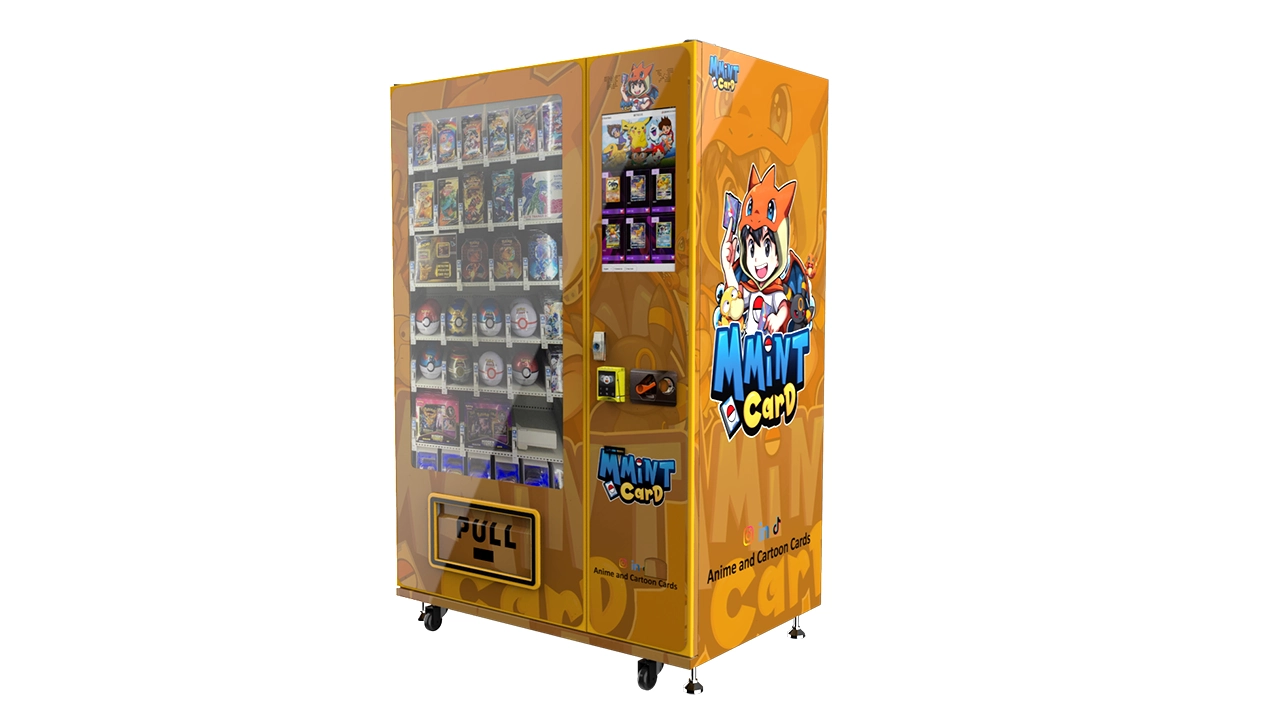
Second, the payment system is absolutely critical in a mall environment. You need to accept credit cards, mobile payments (Apple Pay, Google Pay), and ideally cash for the younger customers who might not have a card yet. A machine that only takes coins is leaving money on the table. I’ve also found that machines with a larger touchscreen tend to perform better because they can display product images and prices clearly, which reduces the number of customers who walk away confused about what they’re buying.
One brand that has consistently performed well in my operations is Zhongda Smart’s 32-inch touchscreen card vending machine. I’m not saying this because they pay me—they don’t—but because their machines have the dual dispensing system that handles both sealed packs and thicker graded slabs without frequent jams. I’ve had one of their units running for over a year with minimal issues, and when I did need a part, the support was responsive. That’s rare in this industry, where many manufacturers are overseas and hard to reach.
When you’re evaluating a machine, ask about the warranty and the availability of spare parts. A machine that costs $2,000 less but requires a three-week wait for a replacement motor is not a bargain. You should also ask about the machine’s network connectivity—most modern units have remote monitoring, which lets you see inventory levels and sales data from your phone. That feature has saved me countless trips to the mall just to check if a slot was empty.
Supplier Selection and Sourcing Cards
Your card supplier is almost as important as your machine. The worst mistake I see new operators make is buying sealed product at retail prices from a local game store or online marketplace. You’ll never make a profit that way. You need wholesale access, which typically means establishing accounts with major distributors like Alliance Game Distributors or GTS Distribution. These distributors supply hobby shops, so you’ll need to present yourself as a legitimate retailer, which means having a business license and possibly a physical address.
The challenge with trading cards is that allocation is real. When a new Pokémon set drops, distributors often allocate product based on your sales history. If you’re new, you might get a small allocation or none at all. That’s where building relationships matters. I’ve spent years cultivating relationships with distributors, and even now, I sometimes have to hustle to get enough stock for a big release. If you’re not prepared to deal with allocation, you might find your machine empty during the exact week when demand is highest.
Another sourcing option is to buy collections and singles, but that’s a different business model. For a vending machine, you want sealed product because it’s easy to stock and the pricing is straightforward. However, I’ve also found that adding a few higher-priced graded slabs can boost your average transaction value. Graded slabs have a higher margin if you buy them right, but they also tie up more capital. I usually keep about 15% of my machine’s inventory value in slabs and the rest in sealed packs.
When you’re vetting a supplier, ask about their return policy and their reliability. A distributor that can’t guarantee delivery dates will leave you with an empty machine during a peak weekend. I’ve also learned to diversify my sourcing—I use two or three different distributors so that if one is out of stock on a hot item, I can get it from another. That flexibility has saved me more than once.
Self-Op, Lease, or Revenue Share: Which Model Works Best?
There are three main ways to run a card vending machine in a mall: you buy the machine and operate it yourself, you lease the machine from a provider, or you enter a revenue-sharing agreement with a location host or a machine provider. Each has its pros and cons, and I’ve used all three at different points in my career.
Self-operating gives you the most control and the highest profit potential, but it also requires the most capital and the most work. You’re responsible for the machine, the inventory, the maintenance, and the relationship with the mall. If you’re only running one or two machines, this is the model I recommend because it teaches you the business from the ground up. The downside is that your capital is tied up in equipment, and if a machine fails or a location goes bad, you’re the one eating the loss.
Leasing a machine is a good option if you’re short on capital or if you want to test a location before committing to a purchase. Lease rates vary, but I’ve seen monthly fees from $150 to $400 depending on the machine’s value and the lease term. The downside is that you’re paying a premium over time, and you might be stuck with a machine that isn’t ideal for your location. I’ve also seen lease agreements that include a mandatory inventory purchase, which can be a bad deal if the supplier’s prices are above market.
Revenue sharing is the model that most malls and entertainment venues push for. In this arrangement, the mall or a third-party provider owns the machine, and you just supply the cards and split the sales. The split is usually 50/50 or 60/40 in favor of the machine owner. This model reduces your upfront cost, but it also reduces your profit per sale. I’ve done revenue share in a few locations where the foot traffic justified the lower margin. It’s a good way to get into a premium location without a huge capital outlay, but it’s not the path to maximum profit.
| Model | Upfront Cost | Monthly Profit Potential | Best For |
|---|---|---|---|
| Self-Op (buy machine) | $10,000 – $20,000 | $800 – $2,500+ | Experienced operators with capital |
| Lease Machine | Low ($500 – $1,000 deposit) | $300 – $800 | Beginners testing the market |
| Revenue Share | Minimal (inventory only) | $200 – $600 | Premium locations, low capital |
In my experience, the self-op model is the only one that gives you the upside to justify the effort. But if you’re a complete beginner and you’re not sure if this is for you, leasing one machine for six months is a smart way to learn without risking $15,000. Just make sure you read the lease terms carefully—especially the clauses about maintenance and what happens if the machine breaks down.
Maintenance, Restocking, and the Hidden Costs
If there’s one thing that kills card vending operations, it’s neglect. A card machine that’s empty or broken doesn’t just lose that day’s sales—it loses the customer’s trust. I’ve seen machines in malls that have been out of order for weeks, and every time a kid walks up and sees the “sold out” sign, that’s a lost customer who might never come back. In this business, your reputation is built one transaction at a time.
Restocking frequency depends on your sales volume, but I generally plan to visit each machine at least once a week. That might sound like a lot, but it’s not just about filling slots—it’s about cleaning the screen, checking for jams, and seeing what’s selling and what’s not. A quick 20-minute visit can save you from a weekend of lost sales. I also use remote monitoring to track inventory levels, which helps me plan my restock trips more efficiently. If I know a machine is down to three packs of a hot item, I can prioritize that location.
Maintenance is another area where operators underestimate costs. Even the best machines will need occasional repairs. I budget about 5% of my monthly gross revenue for maintenance and repair. That covers everything from a stuck dispenser to a dead touchscreen. If you’re not setting aside that money, you’ll be caught off guard when a $300 repair bill hits. In my experience, trading card vending machine maintenance is not as bad as snack machine maintenance, but it’s not negligible either. The card dispensing mechanism is the most delicate part, and it needs regular cleaning to prevent dust buildup.
You also need to think about insurance and taxes. Depending on your jurisdiction, a vending machine business might require a specific license. The U.S. Small Business Administration has a helpful guide on the types of licenses and permits you might need for a retail vending operation, and I’d recommend checking their site for your state’s requirements. Insurance is another cost—I pay about $500 a year for a liability policy that covers my machines. It’s not a huge amount, but it’s a necessary buffer.
Common Mistakes New Operators Make
I’ve seen more operators fail from avoidable mistakes than from bad luck. The most common mistake is overpaying for a machine or buying a cheap machine that can’t handle the job. A $3,000 machine from an unknown brand might seem like a deal, but if it jams twice a week, you’ll lose more in sales and repair costs than you saved upfront. Stick with proven brands, even if they cost a bit more.
The second mistake is ignoring the data. Every card machine I run has a sales log that shows what’s selling and what’s not. If you’re not reviewing that data weekly and adjusting your inventory, you’re flying blind. I’ve seen operators leave the same stale product in a machine for months because they never bothered to check what was moving. The result is a machine full of unsold product and a customer base that stops coming because there’s nothing new.
The third mistake is underestimating the importance of card mix. You can’t just load a machine with Pokémon and hope for the best. You need a mix of price points and franchises. In my machines, I typically carry about 60% Pokémon, 20% sports (football, basketball, baseball), and 20% other (Yu-Gi-Oh, Lorcana, One Piece). That mix isn’t universal—I adjust it based on the mall’s demographics—but it’s a reasonable starting point. If you’re in a mall with a lot of adult sports fans, you might flip the percentages.
Finally, I see operators who don’t plan for the slow season. Card sales, like most retail, have peaks and valleys. The holiday season is huge, and the summer can be strong if you’re near a tourist area. But there are dead months—usually late winter and early fall—where sales drop by 30% or more. If you haven’t budgeted for that, you’ll be scrambling to pay your lease or restock. I keep a cash reserve equal to about three months of operating costs specifically to weather those slow periods.
Legal and Compliance Considerations
Operating a card vending machine in a mall isn’t as simple as just plugging it in. Depending on your state or country, you might need a vending machine permit, a sales tax license, and a business license. In the US, sales tax rules vary by state, and you’re responsible for collecting and remitting tax on every sale. The U.S. Small Business Administration provides a good overview of the licenses you might need, and I’d recommend consulting their resources or a local business advisor before you invest.
In the EU, the rules are different, but the principle is the same: you need to comply with local regulations. Eurostat has data on retail trade and vending, which can give you a sense of the market size in your region. If you’re operating in France, for example, you might hear the term distributeur automatique or borne en libre-service, which refers to self-service kiosks. The compliance requirements are generally straightforward, but you need to know them before you start, not after you’ve been fined.
One often-overlooked legal issue is age restrictions. Trading cards are not age-restricted products, but some graded slabs might have a higher value that could attract attempted theft. I’ve never had a legal issue with this, but I do recommend placing your machine in a well-lit area with good visibility, and if possible, near a security camera. That’s not just for theft prevention—it also makes customers feel safer making a larger purchase.
Is It Worth It? A Realistic Assessment
After all this, you’re probably wondering if the effort is worth the return. My honest answer is: it depends on your situation. If you’re looking for a passive income stream that requires minimal effort, card vending is not it. It requires weekly restocking, constant monitoring, and a willingness to learn the collector market. But if you’re willing to put in the work, the margins are better than almost any other vending category I’ve operated.
Based on my experience, a single card vending machine in a good mall location can generate a net profit of $500 to $1,500 per month after all costs. That’s not a life-changing income from one machine, but it scales. I know operators who run 10 or 20 machines across multiple malls and make a solid six-figure income. The key is replicating your success and managing the logistics efficiently.
The payback period for a new trading card vending machine is typically 8 to 18 months, depending on your location and sales volume. If you’re in a top-tier mall with heavy foot traffic, you might recoup your investment in under a year. If you’re in a slower location, it could take closer to two years. That’s a wide range, but it reflects the reality that location is the dominant variable.
I’ve also seen operators who make money in unconventional ways—like selling the machine itself after a year of operation. Because card machines are in demand, you can often sell a used machine for close to what you paid for it, especially if it’s a well-known brand. That effectively gives you a year of operation for the cost of depreciation, which is minimal if you maintain the machine well.
Choosing the Right Machine Configuration
When you’re ready to buy, you’ll face a choice of configurations. The most common are the standalone floor model with a large touchscreen, the wall-mounted unit, and the smaller countertop version. Each has its place. The floor model is the most eye-catching and can hold the most inventory, but it takes up valuable floor space that the mall might charge you for. The wall-mounted unit is less intrusive and can fit in tighter spaces, but it has less capacity and might be less visible.
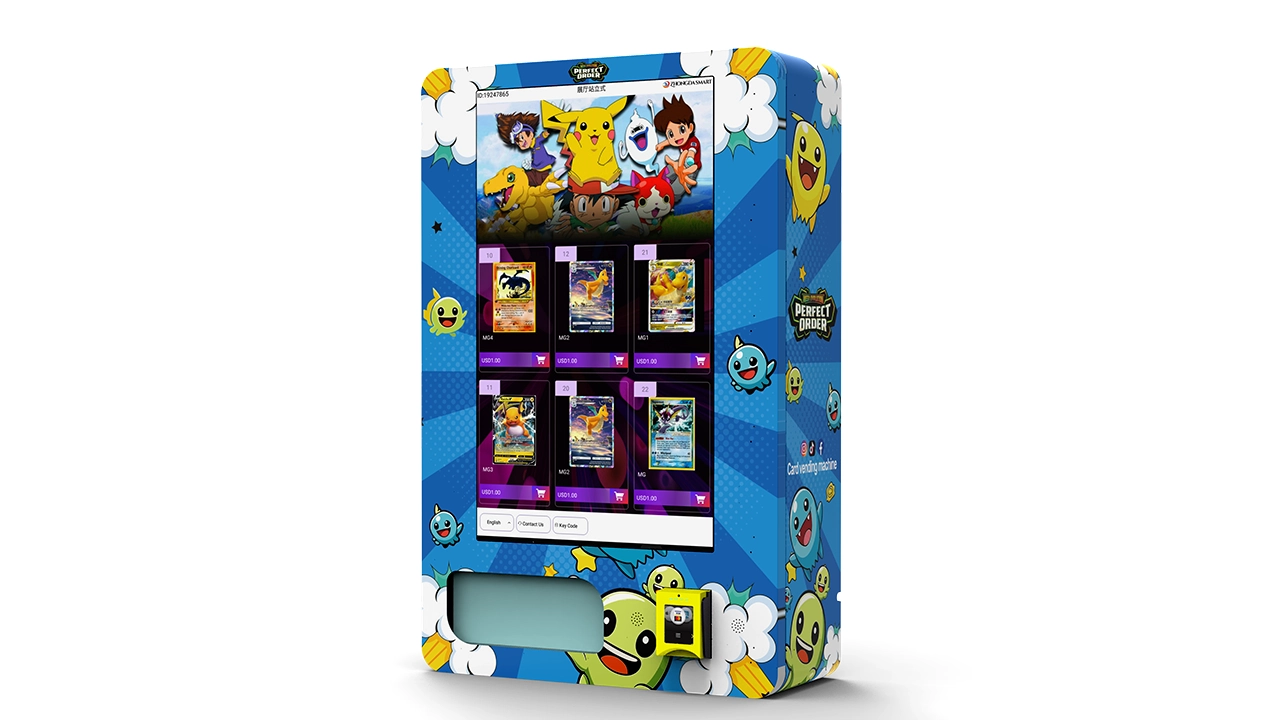
In my experience, the wall-mounted card vending machine is a great option for secondary locations, like a corridor near a cinema or a spot outside a restroom. It doesn’t block foot traffic, and it can still hold a decent amount of inventory. I’ve used them in two malls where the only available space was too narrow for a floor model. They performed about 70% as well as my floor models, which was better than not having a machine there at all.
Another consideration is the screen size. A 32-inch touchscreen is my minimum for a floor model. Anything smaller, and the product images are too hard to see from a distance. The larger screen also allows you to run videos or animations that can draw attention. I’ve seen machines with 43-inch screens, and while they’re impressive, they also cost more and consume more power. For most locations, 32 inches is the sweet spot.
If you’re thinking about a self-service kiosk approach, remember that the user interface matters. Customers should be able to browse the inventory, see prices, and make a selection in under 30 seconds. If the interface is confusing, they’ll walk away. I’ve spent time watching customers interact with my machines, and I’ve made adjustments based on that observation. For example, I learned that showing the card image on the screen before dispensing reduces the number of people who accidentally select the wrong item.
Payment Systems and the Unattended Retail Experience
The payment system is the front door of your machine. If it’s clunky, customers won’t come in. In today’s market, that means you need contactless payments. I’d say about 70% of my sales come from cards or mobile wallets, with the rest in cash. If your machine only takes cash, you’re cutting off the majority of your potential customers. The good news is that modern payment systems are reliable and easy to integrate.
I’ve also experimented with loyalty programs and promotional codes, but I’ve found that they’re not worth the complexity in a vending setting. The exception is a simple “buy X get Y” promotion, which I can run by adjusting the machine’s pricing or adding a bonus pack. For example, during the holiday season, I might offer a free pack with the purchase of three. That type of promotion is easy to implement and drives higher transaction values.
One lesson I learned the hard way is to test the payment system before you install the machine. I once had a machine with a faulty card reader that rejected every card for two days before I noticed. I lost dozens of sales, and worse, I created a group of customers who thought the machine was broken. Since then, I always test the payment system on-site before leaving the machine alone. It sounds basic, but it’s the kind of detail that separates successful operators from those who fail.
Data-Driven Decisions: Using Sales Data to Optimize
If you’re not using the data your machine generates, you’re leaving money on the table. Every machine I run has a dashboard that shows sales by item, sales by hour, and inventory levels. I review this data every week, and I make changes based on what I see. For example, if I notice that a specific set isn’t selling, I’ll mark it down or move it to a less prominent slot. If a new set is selling out in days, I’ll increase my order for the next allocation.
I also track sales by day of the week. In most malls, weekends are the strongest, but I’ve seen surprising variations. One of my mall locations does better on weekdays because it’s near a school and the kids come after classes. Another location peaks on Saturday afternoon, driven by families. Understanding these patterns helps me schedule restocks and plan promotions. For instance, if I know a location peaks on Saturday, I make sure the machine is fully stocked by Friday evening.
The data also helps me decide when to expand. After running a machine for six months, I can project its annual revenue with reasonable accuracy. If it’s performing well, I’ll look for a second location nearby. If it’s underperforming, I’ll either move it or adjust the product mix before giving up. I’ve seen operators who give up too early, and I’ve seen others who hold onto a bad location for too long. The data helps you make the call objectively.
FAQ: Answering the Questions Every New Operator Asks
Over the years, I’ve answered the same questions dozens of times. Here are the ones I get most often, with my honest answers based on what I’ve learned.
Are card vending machines actually profitable?
Yes, they can be, but it’s not automatic. A well-placed machine in a good mall can net $500 to $1,500 per month after all costs. The key variables are location, product mix, and restock discipline. If you neglect any of those, your profits will suffer.
How much does a trading card vending machine cost?
A new, commercial-grade machine with a touchscreen and cashless payment will cost between $8,000 and $18,000. Wall-mounted or smaller units might be less, but you’ll sacrifice capacity and visibility. I recommend buying from a reputable brand like Zhongda Smart, even if it costs a bit more.
How long does it take to recoup the investment?
In my experience, the payback period is typically 8 to 18 months. It depends heavily on your location and sales volume. A top-tier mall with heavy foot traffic can get you there in under a year; a slower location might take closer to two years.
Should a beginner buy or lease a machine?
If you’re completely new and unsure, leasing one machine for six months is a smart way to learn. But if you’re committed to the business, buying is better in the long run because you keep all the profit. Just make sure you have enough capital for the machine, inventory, and a cash reserve.
Where should I place the machine to make the most money?
Look for locations with high foot traffic, especially near the food court, movie theater, or family-oriented stores. Avoid areas where people are just passing through with purpose. I’ve had the best results in spots with high dwell time, where people are lingering and deciding what to do next.
What permits or licenses do I need?
You’ll likely need a business license, a sales tax permit, and possibly a vending machine permit depending on your state or country. The U.S. Small Business Administration has a helpful guide on this. In the EU, check with your local chamber of commerce for specific requirements.
How do I choose a reliable equipment supplier?
Look for a supplier with a track record, a solid warranty, and readily available spare parts. Ask about their support response time. I’ve had good experiences with Zhongda Smart, but the key is to do your own due diligence. Don’t just buy the cheapest option.
What if the machine breaks down?
You need a plan for maintenance. I budget about 5% of monthly gross revenue for repairs. If you’re not hands-on, you’ll need to find a local technician who can service card vending machines. A machine that’s out of order for weeks is a machine that’s losing you money and customers.
How can I reduce restocking and maintenance costs?
Use remote monitoring to track inventory levels and plan your restock trips efficiently. Also, standardize your product mix so you’re not making special trips for one item. And don’t skimp on regular cleaning—it prevents jams and extends the life of the machine.
Before you put any money down, remember that this is a business, not a lottery ticket. The automated retail model works when you treat it with the same discipline as any other retail operation. The machines that fail are the ones that are neglected, poorly placed, or stocked with the wrong product. The ones that succeed are the ones where the operator pays attention to the details.
If you’re serious about this, I’d also recommend looking at the broader vending machine business trends to understand where the market is heading. The card category is growing, but it’s also becoming more competitive. The early movers made the easy money; the operators who succeed now are the ones who bring professionalism and data-driven decision-making to the table.
One final piece of advice: don’t put all your machines in one mall or one market. Diversify your locations so that if one mall’s traffic drops—which happens when a major anchor store closes—you’re not wiped out. I’ve seen operators lose everything because they had 10 machines in one mall that suddenly lost its biggest tenant. Spread the risk, and you’ll be able to weather the storms that hit every retail business eventually.
This article is based on my personal experience and publicly available data. Figures like sales ranges and payback periods are estimates that vary by location, market, and operational efficiency. Always do your own research and consult with a local business advisor before making significant investments.