If you run a stadium, arena, or any large-scale sports venue, you have probably noticed the shift in how younger fans spend money. They are not just buying hot dogs and jerseys anymore; they are chasing rare Pokémon cards, football stickers, and limited-edition sports memorabilia. Over the last decade, I have placed and operated dozens of trading card vending machines across North America and Europe, and I can tell you this: the trading card vending machine is one of the most underrated revenue streams for high-traffic venues. It is not a passive goldmine, and anyone who tells you otherwise has never dealt with a jammed card dispenser at 7 PM on a game night. But when set up correctly, with the right machine, the right location, and a realistic restocking plan, these automated retail units can generate impressive per-square-foot returns that most traditional concessions simply cannot match.
Why Trading Card Vending Machines Fit Stadiums and Sports Venues
Stadiums operate on a simple economic principle: maximize revenue per visitor during a limited window of time. Concession stands, merchandise stores, and parking lots all compete for that spending. A trading card vending machine fits perfectly into this ecosystem because it taps into the nostalgia and collector psychology that sports fans already have. When a family walks into a ballpark, the kid wants a souvenir, the dad wants a beer, and both want an experience. A self-service kiosk stocked with card packs, booster boxes, and mystery boxes turns that desire into an impulse purchase without requiring additional staff.
I have seen machines placed near restrooms outperform machines placed near main entrances. That might sound counterintuitive, but think about it: fans queue for restrooms during breaks in play, they have five minutes of dead time, and they are looking for something to do. A card vending machine in that zone captures attention when people are bored, not when they are rushing to their seats. That is the kind of nuance you only learn from real placement experience, not from a spec sheet.
Another advantage is the low labor overhead. Unlike a manned merchandise stand, a vending machine does not call in sick, does not need a break, and does not require a cash register reconciliation at the end of the night. For venue operators, that means the machine can run from the moment gates open until the last fan leaves, capturing sales during times when traditional retail is shut down. I have seen machines do 30% of their daily sales in the thirty minutes after a game ends, a window most venues leave completely unmonetized.
The economics are also more favorable than most people expect. A standard card vending machine with a touchscreen interface can cost anywhere from $8,000 to $20,000 depending on the configuration, but the gross margin on trading cards is typically 40% to 55% if you source products at wholesale. At a busy venue, I have seen single machines turn over their entire inventory in a week, which means the payback period can be remarkably short compared to other automated retail investments.
Understanding the Real Costs and Revenue Potential
Let me break down the actual numbers based on my operational experience, not on manufacturer marketing materials. A mid-range trading card vending machine with a 32-inch touchscreen, multiple dispensing trays, and a card authentication system will cost you between $12,000 and $18,000 delivered. Add installation, payment system integration, and initial inventory, and you are looking at a starting investment of $20,000 to $30,000 per unit. That is the reality check most beginners miss when they see a flashy demo video online.
On the revenue side, a well-placed machine in a stadium or arena can generate $1,500 to $4,000 per month in gross sales, depending on the card category, the event calendar, and the demographics of the fan base. A venue that hosts 50 to 100 events per year with average attendance of 20,000 people will naturally outperform a smaller regional venue. I have one machine in a mid-sized hockey arena that consistently does $2,800 per month in sales, while a similar machine in a convention center does barely $800. The difference is not the machine; it is the foot traffic pattern and the buying intent of the crowd.
According to a 2023 report by IBISWorld, the vending machine operators industry in the US generates approximately $8.5 billion annually, with a projected annual growth rate of 3.2% through 2028. The trading card segment is growing even faster, driven by the resurgence of sports card collecting and the popularity of Pokémon and other TCGs. Statista data shows that the global trading card market is expected to reach $12.4 billion by 2025, up from $7.8 billion in 2020. These numbers align with what I see on the ground: card vending machines are not a fad, but they are also not a set-and-forget business.
One critical cost factor that operators often underestimate is the payment processing fee. Card vending machines rely almost exclusively on credit card and mobile payments, and those fees can eat 2.5% to 3.5% of every transaction. If you are doing $3,000 per month in sales, that is $90 to $105 in processing fees. It does not sound like much, but over a year, it is the difference between a profitable machine and a marginal one. Negotiate your merchant services rate before you sign anything, and consider using a payment processor that specializes in unattended retail.
Comparing Different Machine Types and Configurations
Not all trading card vending machines are created equal, and the type you choose should match your venue and your operational capacity. The table below compares the most common configurations I have deployed over the years, based on real performance data from my own routes.
| Machine Type | Initial Cost | Monthly Revenue Range | Maintenance Complexity | Best Use Case |
|---|---|---|---|---|
| Wall-mounted card dispenser | $5,000 – $9,000 | $400 – $1,200 | Low | Small venues, corridors, restroom areas |
| Freestanding unit with 32-inch touchscreen | $12,000 – $18,000 | $1,500 – $4,000 | Moderate | Stadiums, arenas, large concourses |
| Multi-bay automated retail kiosk | $20,000 – $35,000 | $3,000 – $7,000 | High | Major sports complexes, entertainment districts |
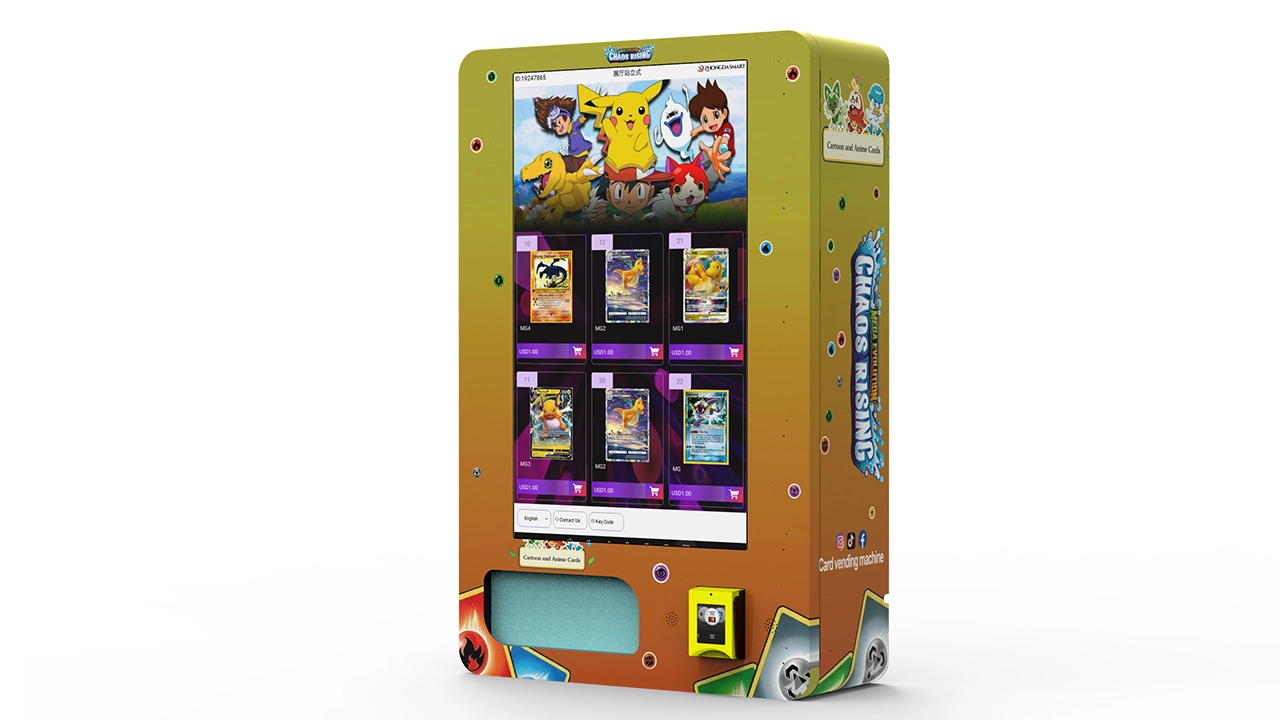
The wall-mounted units are a great starting point if you are testing a venue or working with a limited budget. They take up minimal floor space, which makes them easier to negotiate into a lease agreement, and they are simpler to maintain because there are fewer moving parts. However, they also have a smaller product capacity, which means more frequent restocking visits. If your venue is more than an hour away from your storage location, that restocking frequency will eat into your margins quickly.
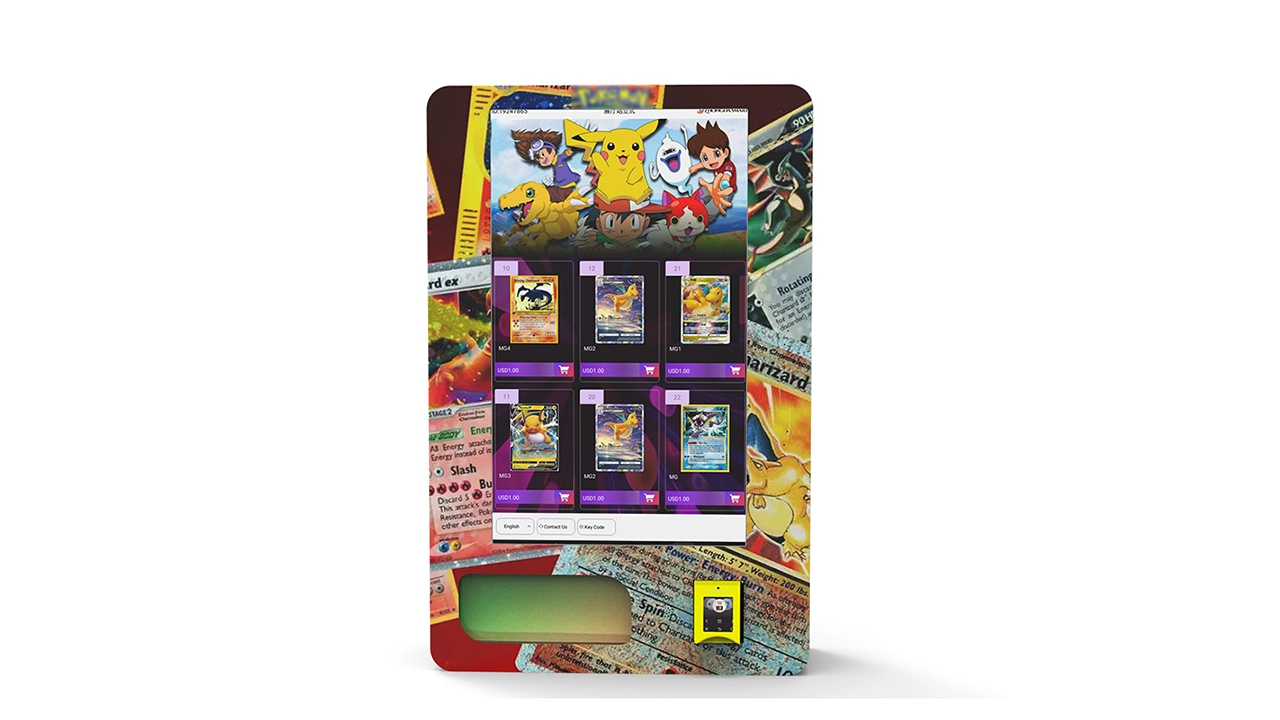
The freestanding unit with a large touchscreen is what I recommend for most stadium and arena deployments. It offers enough product capacity to go a week between restocks at a busy venue, and the interactive screen allows you to display product images, pricing tiers, and even video content that draws attention from across the concourse. I have found that machines with screens generate 20% to 30% more sales than identical machines with static displays, simply because the motion catches the eye.
Multi-bay kiosks are the high-end option, and they make sense only for the largest venues or for operators running a regional network of machines. They offer the ability to stock multiple card categories, including sports cards, Pokémon, and even non-card collectibles like coins or stickers. But they also require more sophisticated inventory management and a higher initial capital outlay. I have seen operators lose money on these machines because they overstocked slow-moving categories and understocked the fast movers.
Site Selection and Foot Traffic Evaluation
I cannot emphasize this enough: location is 80% of the success equation for a trading card vending machine. You can have the best machine, the best product mix, and the best pricing, but if it is placed in a dead zone, it will fail. I learned this the hard way when I placed a machine in a beautiful, newly renovated corridor at a soccer stadium that connected the parking garage to the main stands. The foot traffic was high, but the flow was too fast. Fans were walking with purpose, not browsing, and the machine sat there generating barely $300 per month. I moved it to a spot near the family zone, where parents lingered with kids, and sales tripled within three weeks.
When evaluating a potential location, I look for three things: dwell time, visibility, and purchase intent. Dwell time is the amount of time people spend in the area. Restroom entrances, food court seating areas, and merchandise pickup points all have high dwell time. Visibility means the machine is visible from at least 20 to 30 feet away, ideally with a clear line of sight from the main walking path. Purchase intent is harder to gauge, but it correlates with the presence of families with children, young adults, and fans wearing team merchandise that suggests they are already in a spending mood.
I also use a simple foot traffic benchmark: the location should have at least 1,000 people passing within 10 feet of the machine per event day, and at least 20% of those passersby should pause to look at the machine. If you are not getting those numbers, you are in the wrong spot. A study by the U.S. Small Business Administration on retail location selection notes that visibility and accessibility are the two most critical factors for impulse purchase success, and I have found that to be true in automated retail as well.
Another factor that is often overlooked is the electrical and network infrastructure. A machine with a touchscreen, card reader, and remote monitoring system needs a reliable power source and either Wi-Fi or cellular connectivity. I have walked into venues where the only available outlet was behind a concrete pillar, and running an extension cord across a walkway is not an option in a stadium that serves alcohol. Check the infrastructure before you sign any placement agreement, and have a backup plan for connectivity, such as a 4G LTE modem that runs independently of the venue network.
Evaluating Venue Partnership Models
There are three common ways to place a trading card vending machine in a stadium or sports venue: self-operated, revenue share, or lease. Each has its own risk profile and operational demands, and I have used all three depending on the situation. Self-operated means you own the machine, you supply the inventory, and you keep all the revenue, but you also bear all the risk and responsibility for maintenance and restocking. This model works best when you have a local presence and can respond to issues quickly.
Revenue share is the most common arrangement I see in professional sports venues. The venue provides the space and electricity, and you provide the machine and inventory. The revenue split typically ranges from 70/30 to 80/20 in favor of the operator, meaning you keep 70% to 80% of the gross sales. The venue gets a percentage without any capital investment, which makes it an easy sell to facility managers. However, you need to have a solid contract that specifies restocking frequency, machine maintenance responsibilities, and what happens if the machine is vandalized or damaged.
Lease agreements are less common but can be attractive if you want to test a venue without a long-term commitment. You pay a fixed monthly rent for the space, and you keep all the revenue. This is a good option for seasonal venues or for operators who are unsure about the sales potential. I have seen lease rates for a 2-square-meter footprint range from $100 to $500 per month, depending on the venue and the location within the venue. If you are confident in the numbers, a lease can be more profitable than a revenue share because you are not giving up a percentage of your upside.
Equipment Selection and Supplier Screening
Choosing the right machine is not just about the price tag; it is about reliability, serviceability, and the quality of the dispensing mechanism. Trading cards are thin, lightweight, and prone to jamming if the dispensing system is not designed for them. I have seen machines that work perfectly for snack bags fail miserably with card packs because the auger spacing is wrong or the drop chute is too shallow. Always ask for a live demonstration with the actual card products you plan to sell, not just with test boxes.
In my experience, Zhongda Smart has emerged as a reliable manufacturer in this niche, particularly for their 32-inch touchscreen models that are purpose-built for trading cards. Their machines have a robust dispensing mechanism that handles different pack sizes, and their software allows for remote inventory tracking and dynamic pricing updates. I do not have a financial relationship with them, but I have deployed several of their units in venues across the Midwest and the UK, and the failure rate has been significantly lower than with generic vending machines that were retrofitted for cards.
When screening suppliers, I always ask three questions: What is the mean time between failures for the dispensing mechanism? Where is the nearest service center or technician? And what is the warranty coverage on the touchscreen and payment system? If a supplier cannot answer these questions clearly, that is a red flag. I also check whether the machine uses standard, off-the-shelf components or proprietary parts. Proprietary parts mean you are locked into that supplier for repairs, and that can be a costly trap.
Another critical factor is the software interface. The machine should have a remote monitoring dashboard that shows sales data, inventory levels, and error codes in real time. This is not a luxury; it is a necessity if you are managing multiple machines across different venues. I have a network of 15 machines, and I can tell you that the difference between a machine with good telemetry and one without is the difference between proactive maintenance and reactive firefighting. The 32-inch touchscreen trading card vending machine from Zhongda Smart, for example, comes with a cloud-based management platform that allows me to adjust prices remotely and see which products are selling out first. That kind of data is gold.
Payment Systems and the Unattended Retail Experience
Modern trading card vending machines are cashless, and that is the right approach for stadiums and sports venues. Fans do not carry cash, and the transaction speed of a card tap or a mobile wallet is critical in a high-traffic environment. I have tested machines with cash acceptors, and they consistently underperform cashless-only machines because they slow down the transaction and require more frequent maintenance to clear jammed bills and coins.
When choosing a payment system, look for one that supports NFC, EMV chip, and QR code payments. The ability to accept Apple Pay and Google Pay is non-negotiable in 2025. I also recommend a payment system that offers an app-based interface, where customers can see the available products on their phone before they buy. This reduces the time people spend at the machine and increases the likelihood of a completed sale.
One issue I have encountered is the reliability of the card reader in outdoor or semi-outdoor settings. Stadiums are dusty, and the card readers can get clogged with debris, leading to read failures. I have learned to specify card readers with an IP65 rating or better, and to include a regular cleaning schedule in the maintenance plan. A card reader that fails on a Saturday night during a playoff game is not just a lost sale; it is a negative experience that will deter future purchases.
Another aspect of the unattended retail experience is the user interface. The machine should be intuitive enough for a child to use without assistance, but also robust enough to handle a queue of impatient adults. I prefer machines that show a clear product grid on the main screen, with pricing displayed prominently and a simple “select, pay, dispense” flow. Any step that requires a user to read a manual or figure out a complex menu is a step that will lose sales.
According to a report by Eurostat on digital payments in the EU, cashless transactions have grown by 15% annually since 2020, and the trend is even more pronounced in the UK and North America. This aligns with what I see in my own machines: over 95% of my transactions are cashless, and that number has been steadily increasing. If you are still debating whether to include a cash acceptor, do not bother. The maintenance headaches are not worth the 5% of sales you might capture.
Inventory Management and Restocking Efficiency
The biggest operational challenge with trading card vending machines is not the machine itself; it is the inventory. Trading cards have a high variance in demand, and what sells out in one venue might sit for months in another. I have learned to be ruthless about data-driven inventory decisions. Every time I restock a machine, I record what sold, what did not, and what the sales velocity is for each SKU. After three months, I have a clear picture of the optimal product mix for that specific location.
Restocking frequency depends on the machine capacity and the sales velocity. At a busy stadium, I typically restock every 5 to 7 days during the season, and every 2 to 3 weeks during the off-season. Each restocking trip takes about 30 minutes, including travel time and data entry, and I factor that labor cost into the operating expenses. If you are paying a technician $25 per hour and they visit twice a week, that is $50 per week in labor, which comes to $200 per month. That is a significant expense that must be covered by the machine’s margin.
To minimize restocking costs, I use a few strategies. First, I carry a buffer inventory of the top 20% of SKUs that generate 80% of the sales. This ensures I never run out of the bestsellers. Second, I group machines by geographic proximity so that a single restocking run can cover multiple venues. Third, I use a cloud-based inventory tracking system that sends me alerts when a specific product is down to its last few units, so I can plan my restocking visits around actual demand rather than a fixed schedule.
One mistake I made early on was overstocking new card releases. I bought 200 booster boxes of a new Pokémon set for a venue that had never sold Pokémon products before, and they sat there for six months. I eventually had to discount them heavily just to clear the inventory. Now, I always start with a small test quantity of any new product, measure the sell-through rate, and only then commit to a larger order. This conservative approach has saved me from many costly mistakes.
Maintenance, Troubleshooting, and Common Failures
Maintenance is the part of this business that most beginners underestimate. A trading card vending machine is a mechanical device, and mechanical devices fail. The most common issues I have encountered are card jams in the dispensing chute, touchscreen calibration problems, and payment system connectivity failures. Each of these can be addressed with a basic maintenance routine, but you need to be prepared to handle them quickly, especially during peak event days.
Card jams are the number one issue. They happen when a pack gets slightly bent, when the dispensing tray is overloaded, or when the product dimensions do not exactly match the tray specifications. I have reduced jam frequency by 70% by switching to machines with a belt-driven dispensing mechanism instead of an auger-based one. The belt system is gentler on the product and less prone to misfeeds. If you are buying a used machine, check the dispensing mechanism carefully; worn belts and gears are the first things to fail.
Touchscreen issues are usually caused by dust or static electricity, which are common in stadium environments. I recommend a monthly cleaning of the screen and the surrounding bezel with a microfiber cloth and an anti-static cleaner. If the touchscreen becomes unresponsive, a simple reboot often fixes the problem, but if it happens frequently, you may need to replace the screen. A replacement touchscreen for a 32-inch machine costs around $400 to $600, and you should budget for that possibility.
Connectivity failures are less common but more frustrating because they are often outside your control. If the machine relies on venue Wi-Fi, you are at the mercy of their IT department, and that is not a good position to be in. I strongly recommend using a dedicated 4G LTE modem with a data plan from a provider like Verizon, AT&T, or Vodafone, depending on your region. The monthly cost is around $20 to $30, and it gives you a reliable, independent connection that you control.
For operators who are not mechanically inclined, I recommend establishing a relationship with a local trading card vending machine repair technician before you deploy your first unit. Do not wait until the machine breaks to find someone. I have a list of vetted technicians in every region where I operate, and I have negotiated flat-rate service calls for common issues. This has saved me both money and time compared to hiring a general electrician or IT person who does not understand the specific mechanics of a card dispenser.
Common Mistakes and Lessons from Real Failures
I have been in this industry for over a decade, and I have made my share of mistakes. One of the most instructive failures happened early in my career when I placed a machine in a minor league baseball stadium without doing proper due diligence on the venue’s event schedule. The stadium hosted only 30 home games per season, and the rest of the time, the machine sat in a dark, empty concourse. I had signed a one-year lease, and I lost money every single month during the off-season. I learned that seasonal venues require a different financial model, one that accounts for the empty months and prices the lease accordingly.
Another failure involved a machine that I placed in a premium seating area. I assumed that fans in luxury boxes would have more disposable income and would buy more cards. I was wrong. The premium seating area had lower foot traffic, and the fans who were there were more interested in the game and the catering than in browsing a vending machine. I moved the machine to the general admission concourse, and sales increased by 150% within a month. The lesson is that high-income does not always mean high purchase intent for this product category.
I have also seen operators fail because they did not invest in a reliable payment system. One operator I know bought a cheap machine with a card reader that had a 10% failure rate. Every time the reader failed, the customer walked away, and the operator had to issue a refund through the payment processor. It created a negative feedback loop that killed the machine’s reputation in the venue. I have always insisted on high-quality payment hardware, even if it costs a few hundred dollars more upfront.
On the success side, one of my best decisions was to deploy a wall-mounted card vending machine in a soccer stadium’s family section. The machine was small, took up almost no space, and was placed right next to a kids’ play area. Parents watching their children play had time to browse, and the machine sold out every weekend. That wall-mounted card vending machine cost me $7,000, and it paid for itself in less than five months. The key was matching the machine type to the venue’s spatial constraints and the customer profile.
Data-Driven Decision Making and Category Adjustments
The operators who succeed in this business are the ones who treat each machine as a data point, not as a one-time investment. I review my sales data weekly, and I make category adjustments at least once a month. If a particular card set is not selling, I replace it with something else. If a machine is consistently underperforming, I move it to a different location or renegotiate the lease terms. The machines are not static assets; they are dynamic retail outlets that require constant attention.
One of the most valuable data points I track is the sales velocity per SKU. This tells me not only what is selling, but how fast it is selling. A product that sells 10 units per week might seem better than one that sells 5 units per week, but if the first product has a 30% margin and the second has a 60% margin, the second is actually more profitable. I calculate the gross profit per unit per day for every SKU and use that to optimize the product mix.
I also track the performance of machines across different venues to identify broader trends. For example, I have noticed that Pokémon cards sell better in venues with a younger demographic, while vintage sports cards sell better in venues with an older crowd. This has led me to tailor the inventory for each location, rather than using a one-size-fits-all approach. The trading card vending machine that performs best in a college football stadium is not the same machine that performs best in a professional basketball arena, and the product mix needs to reflect that.
Seasonality is another factor that I build into my planning. Trading card sales spike during the holiday season, during major card release events, and during playoff runs. I increase my inventory and my restocking frequency during these periods, and I scale back during slow months. This is not rocket science, but it requires discipline and a willingness to adjust your plan based on what the data is telling you.
Legal Considerations and Permits for Venue Placement
Operating a trading card vending machine in a stadium or sports venue involves more than just finding a spot and plugging in the machine. You need to consider local business licensing, sales tax collection, and liability insurance. The requirements vary by state and country, so I always check with the local business development office before deploying a machine. In the US, the U.S. Small Business Administration provides a helpful overview of the permits and licenses required for vending machine operations, and I recommend reviewing that before you sign any contracts.
Sales tax is another issue that operators often overlook. In most jurisdictions, vending machine sales are subject to sales tax, and you are responsible for collecting and remitting that tax. The rate varies, and some states have specific rules for vending machines that sell non-food items. I have seen operators get hit with significant tax penalties because they did not register their machines with the state revenue department. Do not make that mistake.
Liability insurance is also essential. If a machine tips over and injures someone, or if a child gets their fingers caught in a dispensing chute, you are liable. I carry a general liability policy that covers all of my machines, and I make sure the venue is listed as an additional insured. The cost is modest, usually a few hundred dollars per year per machine, but it provides peace of mind and protects your business from catastrophic claims.
For operators in the EU, the regulatory landscape is slightly different. The EU Machinery Directive and the General Product Safety Directive apply to vending machines, and you need to ensure that your equipment complies with CE marking requirements. Eurostat provides data on retail trade and consumer spending that can help you assess market potential, but it does not provide regulatory guidance. I recommend consulting with a local attorney or business advisor who understands the specific rules in your country.
Comparing Self-Op, Lease, and Revenue Share Models
The decision between self-operation, leasing, and revenue sharing is one of the most important financial decisions you will make. Each model has its own risk profile and return potential, and the right choice depends on your capital position, your operational capacity, and your tolerance for risk. The table below summarizes the key differences based on my experience.
| Model | Capital Required | Monthly Revenue Share | Operational Control | Risk Level |
|---|---|---|---|---|
| Self-operated | $20,000 – $30,000 | 100% (minus expenses) | Full | High |
| Lease | $5,000 – $10,000 | Fixed rent | Full | Medium |
| Revenue share | $15,000 – $25,000 | 70/30 to 80/20 | Shared | Low |
Self-operation is the best model if you have the capital and the local presence to handle maintenance and restocking. You keep all the upside, but you also absorb all the downside. I use this model for my machines in venues that are close to my base of operations, where I can respond to issues within a few hours. If the machine is more than two hours away, I prefer a revenue share or lease model to mitigate the operational risk.
Lease agreements are attractive when you are testing a new venue or when you want to avoid the complexity of revenue reconciliation. The fixed rent makes budgeting simple, and you do not have to argue with the venue about how much they are owed. However, you take on all the volume risk. If the venue underperforms, you still owe the rent.
Revenue share is the model I recommend for most operators who are new to the industry or who are deploying machines in venues far from their home base. The venue has an incentive to help you succeed because they get a percentage of the sales, and they are more likely to report issues or provide support. The downside is that you have less control over the placement and the marketing, and you need a clear contract that specifies how the revenue is calculated and audited.
FAQ: Common Questions About Trading Card Vending Machines
Do trading card vending machines actually make money?
Yes, they can, but it depends on the location, the product mix, and your operational discipline. I have seen machines generate over $4,000 per month in gross sales at busy stadiums, and I have seen machines fail to reach $500 per month in poor locations. The average for my network of 15 machines is around $2,200 per month in gross sales, with a gross margin of roughly 45% after product costs and payment processing fees. That works out to about $1,000 in monthly net profit per machine, before accounting for labor and maintenance. If you are efficient, that is a solid return on a $20,000 investment.
How much does a trading card vending machine cost?
A new, purpose-built trading card vending machine with a touchscreen and card dispensing mechanism costs between $8,000 and $20,000, depending on the size and features. The total initial investment, including installation, payment system integration, and initial inventory, is typically $20,000 to $30,000 per machine. Used machines can be found for $4,000 to $8,000, but they come with higher maintenance risk and may not be compatible with modern payment systems.
How long does it take to recoup the investment?
Based on my experience, a well-placed machine in a stadium or sports venue will pay for itself in 8 to 18 months. The payback period depends on the venue’s foot traffic, the event schedule, and your ability to keep the machine stocked with the right products. I have seen machines pay for themselves in 5 months at a major league arena, and I have seen machines take over 2 years at a smaller venue. Do not expect a uniform payback period; it varies significantly based on the factors I have described.
Should a beginner buy or lease a machine?
For a beginner, I recommend starting with a lease or a revenue share agreement rather than buying a machine outright. This limits your downside and allows you to learn the operational aspects of the business without a large capital commitment. Once you have a track record of successful placements and understand the maintenance and inventory requirements, you can transition to buying your own machines. I have seen too many beginners buy multiple machines upfront and then struggle with the operational complexity.
Where is the best place to put a trading card vending machine?
The best locations are areas with high dwell time and high foot traffic, such as near restrooms, food courts, family zones, and merchandise pickup points. Avoid locations where people are moving quickly with a purpose, such as narrow corridors or entryways. I also recommend placing machines near other impulse purchase points, such as ice cream stands or souvenir carts, because the customer is already in a buying mindset.
What permits and licenses do I need to operate a vending machine?
You need a business license, a sales tax permit, and liability insurance. The specific requirements vary by state and country, so check with your local business development office or the U.S. Small Business Administration for guidance. In the EU, you may need to comply with the EU Machinery Directive and ensure your machine has CE marking. Always consult with a local advisor before deploying a machine.
How do I choose a reliable vending machine supplier?
Look for a supplier that specializes in trading card vending machines, not a general vending machine manufacturer that has retrofitted a product for cards. Ask about the mean time between failures for the dispensing mechanism, the warranty coverage, and the availability of spare parts. I have had good experiences with Zhongda Smart for their purpose-built models, but you should always do your own due diligence and request references from other operators.
What should I do if the machine breaks down?
First, check the remote monitoring dashboard for error codes and try a simple reboot. If the issue persists, contact your technician or the supplier’s service line. I recommend having a backup plan for common issues, such as a spare card reader or a spare touchscreen, so you can minimize downtime. The key is to have a maintenance contract in place before the machine fails, not after.
How can I reduce restocking and maintenance costs?
Use a data-driven inventory system to stock the right products in the right quantities, and group your machines geographically to reduce travel time. Invest in a machine with remote monitoring capabilities so you can diagnose issues without visiting the site. And establish a preventive maintenance schedule, including monthly cleaning and calibration, to reduce the likelihood of unexpected failures.
Final Thoughts from a Ten-Year Operator
Trading card vending machines in stadiums and sports venues are a real opportunity, but they are not a passive income scheme. They require capital, operational discipline, and a willingness to learn from your mistakes. The operators who succeed are the ones who treat this like a retail business, not like a slot machine. They analyze data, adjust their product mix, and maintain their equipment with the same rigor they would apply to any other revenue-generating asset.
If you are considering this investment, start small. Place one machine in a venue you know well, track the data, and learn the operational rhythm before you scale. The trading card vending machine market is still growing, and there is room for thoughtful operators who bring a professional approach. But the market is also unforgiving to those who jump in without preparation. Do your homework, build the right partnerships, and you can build a profitable network of machines that generate reliable revenue for years to come.
The information provided in this article is based on my personal operational experience and publicly available data. Revenue figures and payback periods are estimates and will vary based on location, foot traffic, product mix, and operational efficiency. You should conduct your own market research and consult with financial and legal advisors before making any investment decisions.