If you’re serious about putting a trading card vending machine into operation, the first question is almost always the same: how much does a TCG vending machine cost? The honest answer, based on my years running automated retail routes across the US and parts of Europe, is that you’re looking at roughly $6,500 to $18,000 for a new unit, with the total turnkey investment—including shipping, payment processing setup, initial card inventory, and site prep—landing between $12,000 and $30,000 per location. That range frustrates people who want a clean number, but the spread reflects real differences in screen size, security features, software, and whether you buy from a manufacturer or a reseller. What matters more than the sticker price is what that machine can do in your specific location, and that’s where most new operators get tripped up.
I’ve been in the vending industry for over a decade, and I’ve seen the trading card segment explode in ways that traditional snack and soda vending never did. The economics are different, the customer behavior is different, and the failure modes are different. If you’re coming from conventional vending, you need to unlearn a few habits. If you’re new to automated retail entirely, you need a realistic picture of what the machine costs, what it earns, and where it fails. This guide is built on my own experience, some painful mistakes, and the operational data I’ve collected from my own routes and from colleagues who run card vending in malls, game stores, and even laundromats.
The Real Price Range for a TCG Vending Machine
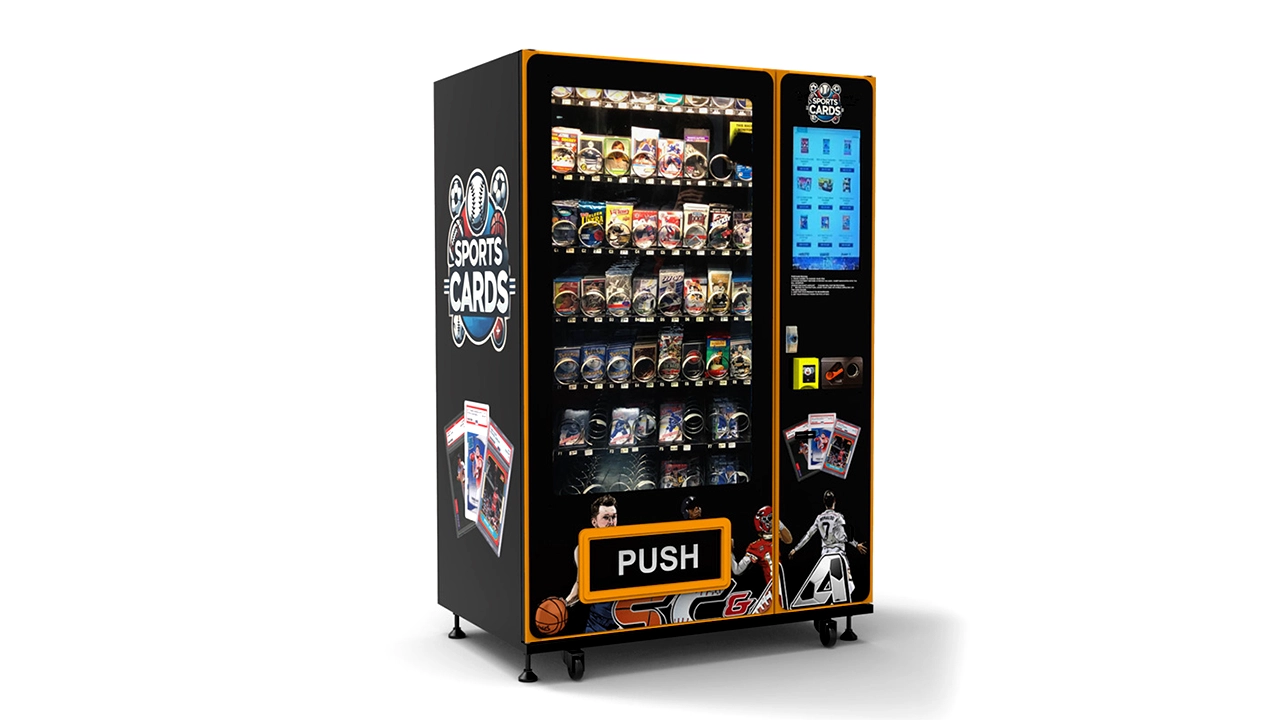
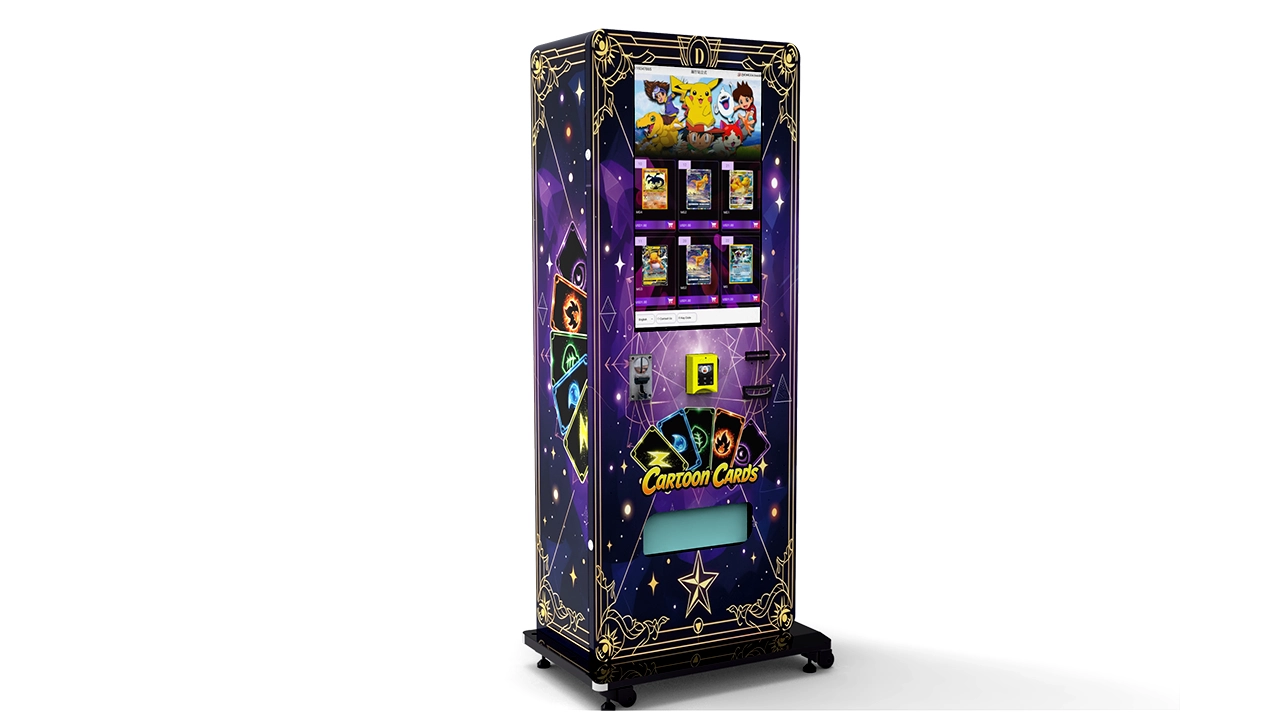
Let’s start with the hardware itself, because that’s what most people price out first. A basic trading card vending machine—by which I mean a unit with a few spiral or coil-driven shelves designed for sealed booster packs, boxes, and maybe some single-card holders—starts around $6,500. These entry-level machines are usually 32 to 43 inches wide, have a simple 10- or 15-inch touchscreen, and come with basic inventory tracking. They work, but they’re not flashy, and they don’t do much beyond dispensing product.
Mid-range machines, which I’d say most serious operators should consider, run between $9,000 and $14,000. This tier includes larger screens, better lighting, more secure locking mechanisms, and software that lets you adjust pricing remotely, monitor sales in real time, and even run promotions. Some of these units have heated or cooled compartments, which matters if you’re selling fragile items or if your location has temperature swings. I’ve also seen combination machines that mix card vending with other collectibles like coins or sports memorabilia, and those push the price up further.
At the high end, you’re looking at $15,000 to $18,000 or more for a premium unit with a 32-inch touchscreen, custom cabinetry, advanced security features like biometric locks or remote camera monitoring, and software that integrates with your inventory system. These machines are built to be showpieces, and they draw attention. But here’s the thing: a more expensive machine doesn’t automatically mean more profit. I’ve seen $16,000 machines sit in low-traffic locations while a $7,000 used unit in the right game store does three times the volume. The machine matters, but the location matters more.
You also need to factor in costs beyond the machine itself. Shipping a heavy vending machine can run $300 to $800 depending on distance and whether it ships by freight or LTL. Installation isn’t usually complicated—most units just need a standard 110V outlet—but if you need to run power to a spot that doesn’t have it, that’s an electrician visit, which can cost $200 to $500. Payment processing setup, including a card reader and possibly a cashless system, adds another $200 to $600. And then there’s the inventory, which is the part that surprises most people.
Initial card inventory for a small machine is easily $1,500 to $3,000 if you’re stocking sealed product from Pokémon, Yu-Gi-Oh!, and Magic: The Gathering. If you want to include single cards or higher-value items, your initial stock could be $5,000 or more. That’s not a one-time cost, either. You’ll need to replenish, and if you’re buying from distributors, you’ll need to maintain enough cash flow to keep your best-selling items in stock. Many operators underestimate how much working capital they need beyond the machine purchase.
What I Learned from a Failed Placement
I want to share a failure from early in my card vending days, because it taught me more than any successful placement did. About four years ago, I placed a mid-range card machine in a suburban shopping strip that had a comic book store, a nail salon, and a dollar store. The comic shop owner was enthusiastic, foot traffic looked decent on weekends, and the rent was low—only $150 a month for the floor space. I thought I had found a winner.
The machine sat there for three months, and the numbers were brutal. Average monthly sales were around $400, which barely covered the rent, my restocking labor, and the payment processing fees. The problem wasn’t the machine or the product—it was the customer profile. The comic shop attracted mostly older collectors who already had their own sources. They didn’t trust a machine for high-value items, and the foot traffic from the nail salon and dollar store wasn’t interested in trading cards. I pulled the machine after three months and took a loss on the placement, the installation, and the time I spent driving out to restock a machine that was never going to work.
That experience pushed me to be far more disciplined about site evaluation. Now, before I even talk about price, I look at the location’s existing customer behavior. Are there already people buying trading cards in that area? Is there a game store, a hobby shop, or a toy section that moves collectibles? If the answer is no, I walk away, no matter how cheap the rent is. A TCG vending machine is not a traffic generator by itself. It’s a convenience and impulse purchase channel that works best when placed near an existing audience.
What a Successful Placement Looks Like
The flip side of that failure is a placement I still run today. A few months after pulling out of the strip mall, I put a similar machine inside a well-established board game café in a mid-sized university town. The café already had regular customers who played card games on weekends, and the owner was happy to host the machine because it gave his customers another reason to stay longer. The rent was higher—$400 a month—but the machine did over $1,800 in sales in its first full month. That’s a gross margin of roughly 40% on sealed product, which means I was clearing around $720 before rent, restocking, and processing fees. After all costs, I was netting about $450 a month from that one machine.
The key difference wasn’t the price of the machine or the type of product I stocked. It was the location’s existing relationship with the audience. The café didn’t need me to create demand; it already had demand, and my machine just captured a slice of it. If you’re evaluating a location, ask yourself whether the people who walk past that spot are already buying trading cards somewhere. If they are, you have a chance. If they’re not, you’re fighting an uphill battle.
Comparing Machine Types and Costs
To give you a clearer picture, here’s a comparison table based on my own experience and the typical price points I see from manufacturers and resellers. These are real numbers from the US market, but keep in mind that prices vary by region, supplier, and the current exchange rate if you’re buying from overseas manufacturers.
| Machine Type | Typical New Price | Screen Size | Ideal Location | Expected Monthly Sales Range |
|---|---|---|---|---|
| Entry-level spiral machine | $6,500 – $8,500 | 10–15 inch | Game stores, hobby shops | $300 – $800 |
| Mid-range touchscreen machine | $9,000 – $14,000 | 15–24 inch | Malls, entertainment venues | $800 – $2,000 |
| Premium large-format machine | $15,000 – $18,000+ | 24–32 inch | High-traffic retail, tourist areas | $1,500 – $3,500+ |
| Wall-mounted compact unit | $4,500 – $7,000 | 8–15 inch | Laundromats, convenience stores | $200 – $600 |
These sales ranges are based on my own placements and conversations with other operators, not official statistics. Your results will vary depending on location, product mix, and how often you restock. The wall-mounted units are a newer category that has grown in popularity because they take up less space and can fit into locations that don’t have room for a full-size machine. They’re also cheaper to ship and install, which makes them attractive for testing a new area without a huge upfront investment.
Site Selection: What to Look For and What to Avoid
Site selection is the single most important factor in whether your trading card vending machine makes money. I’ve already mentioned that existing demand matters, but let’s get more specific. I look for locations with at least 500 to 1,000 people passing by per day, ideally with a concentration of people in the 15 to 40 age range. That’s the core demographic for trading cards, and it’s a bit different from the general vending demographic. A busy office building might generate a lot of foot traffic, but if the workers are mostly over 50 and not interested in collectibles, the machine won’t do well.
I also pay attention to the location’s operating hours. A machine in a mall that closes at 9 PM will do less volume than a machine in a 24-hour convenience store, even if the mall has more daily foot traffic. The reason is that trading card purchases often happen late at night or during events, and having a machine accessible when other card sources are closed can be a huge advantage. I’ve seen machines in 24-hour gas stations do surprisingly well, especially in college towns where students are up late.
Rent is another consideration, but it shouldn’t be your first filter. A location that charges $500 a month but does $2,500 in sales is better than a location that charges $100 a month but does $400 in sales. I calculate rent as a percentage of gross sales and try to keep it under 25%. If the rent is going to eat more than a quarter of your revenue, you need very high volume to justify it. That’s a rule I’ve developed from tracking my own placements over the years.
The Cost Breakdown No One Talks About
Beyond the machine and inventory, there are ongoing costs that many new operators don’t budget for. Payment processing fees are usually 2.5% to 3.5% per transaction, which doesn’t sound like much but adds up when you’re doing hundreds of transactions a month. If you’re using a cashless payment system that requires a monthly subscription, that’s another $20 to $50 per month. And if you’re paying for cellular connectivity so the machine can report sales remotely, that’s $10 to $30 per month per machine.
Maintenance is another cost that catches people off guard. Vending machines break, and trading card machines have moving parts that jam, sensors that go bad, and screens that crack. I set aside about 5% of my monthly gross sales for maintenance and repairs. That covers things like replacing a jammed spiral, fixing a card reader, or paying a local technician to diagnose an issue. If you’re in a remote area and don’t have a local vending repair person, you might need to ship the machine back to the manufacturer, which can cost $200 or more in freight alone.
Restocking labor is also a cost, even if it’s your own time. I spend about one to two hours per week per machine on restocking, cleaning, and checking for issues. If you value your time at $25 an hour, that’s $100 to $200 a month in labor per machine. That’s a real cost, and it’s one that many part-time operators ignore because they think of their own time as free. It’s not.
How Long Until You See a Return
The payback period for a trading card vending machine depends heavily on your sales volume and your total investment. Let me give you a realistic example. Suppose you buy a mid-range machine for $11,000, spend $1,000 on shipping and installation, and put $2,500 into initial inventory. That’s a total investment of $14,500. If the machine does $1,200 in monthly sales with a 40% gross margin, that’s $480 in gross profit. Subtract $300 for rent, $40 for payment processing, $30 for connectivity, and $60 for maintenance reserve, and you’re left with $50 in net profit per month. That’s a payback period of over 20 years, which is obviously terrible.
Now let’s look at a better scenario. The same machine in a high-traffic game store does $2,800 in monthly sales. Gross profit at 40% is $1,120. Rent is $500, payment processing is $90, connectivity is $30, and maintenance reserve is $140. That leaves $360 in net profit per month. The payback period is around 40 months, or roughly three and a half years. That’s more realistic, but it’s still not a get-rich-quick scheme. If you can find a location that does $4,000 in monthly sales, which I’ve seen in a few exceptional spots, the payback drops to around two years.
I want to be clear that these are my own estimates from my own operations, not official industry statistics. The vending industry data I’ve seen, such as the IBISWorld vending machine operation report, suggests that average profit margins for vending operators are around 10% to 15% of revenue. That aligns with my experience. Trading cards have higher margins than snacks, but they also have higher product costs and more volatility, so the overall picture is similar.
New vs. Used Machines: The Risk Tradeoff
I get asked a lot whether buying a used machine is a good idea. It can be, but it’s risky. Used trading card vending machines are rare because the market is still relatively young. Most used machines you’ll find are either old snack vending machines that someone converted to hold cards, or they’re card-specific machines that a failed operator is selling. Both have issues. Converted snack machines often have spiral sizes that don’t fit card products well, and they lack the software features you need for remote pricing and inventory tracking. Failed operator machines might have hidden mechanical problems that the seller isn’t disclosing.
If you do buy used, budget for repairs. I’ve seen used machines sell for $3,000 to $5,000, but then need $1,000 or more in parts and labor within the first few months. You might save money upfront, but you lose it in downtime and frustration. For a first-time operator, I generally recommend buying new from a reputable manufacturer, even if it costs more. The warranty alone is worth the price difference, because you’ll likely need it while you’re learning how to operate the machine.
How to Evaluate a Supplier
Not all vending machine manufacturers are the same, and this is where you can save or lose a lot of money. I’ve bought machines from several suppliers over the years, and I’ve learned to ask specific questions before committing. First, ask about the warranty. A good manufacturer will offer at least one year of parts and labor coverage, and they should have a service network or at least a reliable phone support line. Second, ask about software updates. Card vending machines rely on software for inventory tracking, remote monitoring, and payment integration. If the manufacturer doesn’t provide regular updates, your machine will become outdated quickly.
Third, ask about spare parts availability. If you need a new spiral or a sensor, can you order it directly, and how long does shipping take? I’ve been burned by suppliers who took weeks to ship a $15 part, leaving my machine idle and losing money. Fourth, ask about customization. Can you adjust the machine’s layout to fit different product sizes? Can you change the screen graphics or add a logo? These details matter for branding and for adapting to different card products.
One manufacturer I’ve worked with on several projects is Zhongda Smart. They’re a Chinese automated retail equipment maker that has been expanding into the card vending space, and I’ve found their machines to be solid for the price. Their mid-range and premium units have good build quality, and their software is more advanced than what you’ll find from some US-based resellers. That said, I’d still recommend doing your own due diligence, checking references, and asking for a demo video of the actual machine you’re considering. If a supplier won’t provide a video or a live demo, that’s a red flag.
Self-Operate vs. Lease vs. Revenue Share
Another decision you’ll face is whether to buy and operate the machine yourself, lease it from a provider, or enter a revenue-sharing agreement with a location owner. Each model has tradeoffs, and the right choice depends on your capital, your time, and your risk tolerance.
| Model | Upfront Cost | Monthly Commitment | Control | Profit Potential |
|---|---|---|---|---|
| Self-operate (buy) | $12,000 – $30,000 | Rent + fees | Full | Highest |
| Lease from provider | $0 – $2,000 deposit | $300 – $800/month | Limited | Moderate |
| Revenue share with location | $0 – $5,000 | 10% – 30% of gross | Shared | Moderate |
Leasing is attractive if you don’t have the capital to buy a machine upfront, but you’ll pay more over time, and you’ll have less control over pricing and product selection. Revenue sharing can work well if you find a location owner who’s willing to host the machine in exchange for a percentage of sales, but you need to be careful about how the agreement is structured. I’ve seen revenue share deals where the location owner expected the machine operator to handle all maintenance and restocking, which is fair, but I’ve also seen deals where the location owner wanted a cut of gross sales before costs, which is not fair. Make sure you define the terms clearly in writing.
Restocking and Inventory Management
Restocking is the daily grind of card vending, and it’s where most operators lose money if they’re not careful. The key is to track what sells and what doesn’t, and to adjust your product mix accordingly. I use the machine’s software to see which items are selling fastest, and I reorder those items before they run out. I also rotate out slow-moving items after a month or two, because dead stock ties up your cash and takes up space.
One mistake I made early on was stocking too many high-value items. I thought that having expensive booster boxes and rare singles would attract serious collectors, but it actually created a problem. The machine had fewer items to sell because each item took up more space, and the high price tags made some customers hesitant to buy from a machine. I learned that a mix of low-priced boosters ($4 to $10) and mid-priced items ($15 to $30) sells better than a machine full of $50+ products. The impulse buyers want something affordable, and the serious collectors are more likely to buy from a human behind a counter.
Restocking frequency depends on your sales volume. A machine that does $2,000 a month will need restocking about once a week, while a slower machine might only need attention every two weeks. I’ve found that checking the machine weekly is a good habit, even if you don’t need to restock, because it lets you spot issues like a jammed spiral or a cracked screen before they become bigger problems. For a more detailed look at restocking strategies and inventory management, I’ve written about my approach to managing card vending inventory in a separate post.
Maintenance: What Breaks and What to Do
Vending machine repair is an inevitable part of this business, and you need to be prepared for it. The most common issues I’ve encountered are jams in the spiral mechanism, faulty card readers, and connectivity problems with the remote monitoring software. Jams happen when a product gets stuck or when the spiral is loaded incorrectly. Card readers fail when they get dirty or when the payment processor updates its firmware. Connectivity issues are usually related to the cellular network or the machine’s software.
For minor issues, I’ve learned to do basic repairs myself. I keep a small toolkit with screwdrivers, pliers, and spare sensors, and I’ve watched enough YouTube tutorials to handle simple jams and sensor replacements. For more complex issues, like a broken compressor in a cooled unit or a screen that needs replacing, I call a local vending repair technician or the manufacturer’s service line. The key is to have a plan before something breaks, because downtime costs you money and erodes customer trust.
If you’re considering a wall-mounted card vending machine for a smaller space, the maintenance requirements are similar, but the compact design can make some repairs more difficult. I’ve used wall-mounted card vending machines in a couple of convenience stores, and they’re convenient for tight spaces, but you need to be prepared for slightly more awkward repairs due to the smaller cabinet.
Payment Systems and the Customer Experience
Modern card vending machines need to accept cards, mobile payments, and ideally some form of contactless payment. Cash-only machines are a non-starter for this product category, because the average transaction is $10 to $30, and most people don’t carry that much cash. I’ve seen machines that only accept cash do a fraction of the volume of machines with full cashless support.
Payment processing adds a layer of complexity, though. You’ll need to choose a payment gateway that integrates with your machine’s software, and you’ll need to pay processing fees. Some manufacturers offer their own payment processing, but you’re often better off using a well-known provider like Square, Stripe, or a vending-specific processor like Nayax or USA Technologies. These providers have track records, and their hardware is reliable. I’ve had good experiences with Nayax on several of my machines, and I like their remote monitoring dashboard.
The customer experience also depends on the machine’s interface. A slow, laggy touchscreen will frustrate customers, especially younger ones who expect a smooth digital experience. I recommend spending the extra money on a machine with a responsive screen and an intuitive interface. If you’re looking for a machine that delivers a good customer experience, I’ve reviewed a 32-inch touchscreen trading card vending machine that does a great job of showcasing product and guiding the buyer through the purchase.
Legal and Regulatory Considerations
Depending on where you operate, you may need a business license, a resale certificate, or a vending permit. In the US, the requirements vary by state and city, so you’ll need to check with your local government. In the EU, the rules are different, and you’ll need to comply with local tax and consumer protection laws. I operate in multiple US states, and I’ve found that the easiest way to handle this is to work with a local accountant or business advisor who knows the vending regulations in your area.
You also need to think about liability. If your machine is in a public space, you’re responsible for ensuring it’s safe and doesn’t cause injury. That means checking for loose parts, ensuring the electrical wiring is up to code, and keeping the area around the machine clean. Some location owners will require you to carry liability insurance, so it’s worth getting a quote from an insurance provider that covers vending operations.
For a broader look at the regulatory side, the U.S. Small Business Administration has a useful guide on getting the necessary tax IDs and permits, and you can check your state’s revenue department for specific vending requirements. In the EU, you can refer to Your Europe’s business portal for guidance on cross-border selling and local compliance.
Realistic Revenue Expectations
I’ve seen a lot of marketing material from manufacturers that shows a card vending machine making $5,000 a month or more, and I’m here to tell you that’s the exception, not the rule. In my experience, a well-placed machine will do $1,000 to $2,500 in monthly sales. A great location might push that to $3,000 or $4,000, but those are rare, and they usually come with higher rent or a revenue share agreement that eats into your margin. A poorly placed machine will do under $500 a month, and you’ll be losing money from the start.
The gross margin on sealed trading card product is typically 30% to 45%, depending on how much you pay and how much you sell above retail. I’ve seen some operators sell single cards at a much higher margin, sometimes 100% or more, but that requires a system for grading and pricing singles, and it adds a lot of labor. For most operators, sealed product is the bread and butter, and singles are a side experiment.
I want to give you a concrete example from my own route. One of my mid-range machines in a mall food court area does about $2,200 a month in sales. The rent is $450, payment processing is $70, connectivity is $25, and maintenance reserve is $110. My gross profit at 40% margin is $880, so my net profit is around $225 a month. That’s not a life-changing amount, but the machine cost me $12,500 all-in, so my payback is around 55 months. That’s longer than I’d like, but the machine is in a stable location, and it’s providing a small recurring income. If I can find a better location for the same machine, the payback could drop significantly.
Common Mistakes I See New Operators Make
I’ve made a lot of mistakes myself, and I’ve watched other operators make the same ones. The most common mistake is overpaying for the machine. I see new operators buy a $15,000 premium machine when a $9,000 mid-range machine would have done the same job. They’re drawn in by the big screen and the flashy design, but they don’t realize that the location, not the machine, determines the revenue. The second most common mistake is underestimating the importance of inventory management. A machine full of product that doesn’t sell is a money pit. You need to track your sales data and adjust your product mix regularly.
The third mistake is ignoring maintenance until it’s too late. A machine that’s out of order for two weeks loses sales and customer trust. I’ve seen operators let a jammed machine sit for a month because they didn’t have a maintenance plan. By the time they fixed it, the location owner was upset, and the customers had found other sources. The fourth mistake is not negotiating the location agreement. Many location owners will ask for a high rent or a large revenue share, but they’re often willing to negotiate if you present a realistic revenue projection. Don’t accept the first offer.
When to Consider a Second Machine
Once you have one machine running smoothly and generating a consistent profit, it’s natural to think about expanding. I recommend waiting until you have at least six months of data from your first machine, and until you’ve built a restocking and maintenance routine that you can replicate. Adding a second machine in a different location is a good way to test whether your success was location-specific or replicable. If your second machine does well, you have a model that can scale. If it doesn’t, you need to go back to your site evaluation criteria.
I also recommend starting with a used or lower-cost machine for your second placement, so you’re not overcommitting capital before you’ve proven the model. I’ve seen operators scale too quickly, adding five or six machines in a year, only to find that half of them are losing money. It’s better to grow slowly and learn from each placement.
The Role of Data and Sales Analytics
Data is your best friend in this business. I use the remote monitoring software on my machines to track sales by item, by time of day, and by day of week. That data helps me decide what to stock, when to restock, and whether to adjust pricing. For example, I noticed that one of my machines sells more on Friday evenings and Saturday afternoons, so I make sure to restock on Thursday to have a full machine for the weekend. I also track which products have the highest sell-through rate, and I reorder those items first.
If you’re not using a machine with remote monitoring, you’re operating blind. You’ll be restocking based on guesses, and you’ll miss out on opportunities to optimize your product mix. I’ve written about the importance of tracking sales data for card vending, and I can’t overstate how much it improves your bottom line.
How to Lower Your Restocking and Maintenance Costs
There are a few ways to reduce your ongoing costs. First, choose a machine that’s easy to restock. Some machines have awkward shelf designs that make loading slow and frustrating. I’ve spent time with machines where restocking took 30 minutes, and others where it took 10. The faster you can restock, the less labor you’ll spend. Second, buy product in bulk from distributors to get better prices, but only for items that sell well. Buying in bulk for a slow-moving item just ties up your cash. Third, negotiate for lower payment processing fees by shopping around. Some processors offer lower rates for higher volume, and it’s worth asking for a better deal.
Fourth, create a maintenance checklist and stick to it. I check the machine’s screen, card reader, and spirals every time I restock, and I clean the machine’s exterior and interior once a month. This prevents small issues from becoming big ones. Fifth, keep a stock of common spare parts on hand, like sensors and small motors. This lets you fix minor issues immediately instead of waiting for a shipment.
Buying from Zhongda Smart and Other Suppliers
I mentioned Zhongda Smart earlier, and I want to give you a bit more context on working with them. I purchased a mid-range card vending machine from them last year for a placement in a shopping center, and the experience was generally positive. The machine arrived well-packaged, the software was easy to set up, and the remote monitoring worked as advertised. I did have one minor issue with a sensor that needed replacing after about two months, but their support team sent a replacement part quickly, and I had it fixed within a few days.
That said, I’d give the same advice I give for any supplier: ask for references, check the warranty terms, and make sure you understand the shipping and import costs if you’re buying from overseas. The price might be lower than a US-based supplier, but the shipping time and potential customs fees can eat into your savings. I’ve also seen operators have trouble with after-sales support from overseas manufacturers, so make sure you have a clear communication channel before you pay.
Final Thoughts on the Investment
A trading card vending machine is a real business investment, not a passive income hack. The initial cost is manageable for many small business owners, but the ongoing effort and the risk of a bad location are real. I’ve seen operators make good money with a single, well-placed machine, and I’ve seen others lose money because they bought the wrong machine, put it in the wrong place, or didn’t manage their inventory properly.
My advice is to start small, do your homework on the location, and be disciplined about tracking your numbers. If you can find a spot with existing demand for trading cards, and if you’re willing to put in the time for restocking and maintenance, there’s a decent chance you’ll build a profitable small business. But if you’re looking for a hands-off money printer, this isn’t it.
Before you commit, I’d also recommend reading about the common pitfalls in card vending machine placement, and checking out a detailed breakdown of a card vending machine purchase to see the full cost structure from someone who’s been through it. And remember, the numbers I’ve shared here are based on my own experience and should be treated as estimates, not guarantees. Your local conditions, product availability, and customer behavior will all affect your results.
Disclaimer: The information in this article is based on my personal experience in the vending industry and on publicly available data sources. It is not financial advice, and you should conduct your own research and consult with a professional before making any investment decision.
Frequently Asked Questions
Are vending machines profitable?
Vending machines can be profitable if they’re placed in locations with enough foot traffic and if the product mix matches customer demand. In my experience, a well-placed trading card vending machine can generate a net profit of $200 to $500 per month after all costs. However, many machines in poor locations lose money, so profitability depends heavily on site selection and ongoing management.
How much does a TCG vending machine cost?
A new TCG vending machine typically costs between $6,500 and $18,000 depending on the size, screen type, software features, and manufacturer. The total investment, including shipping, installation, payment processing setup, and initial card inventory, usually lands between $12,000 and $30,000.
How long does it take to recoup the investment?
Based on my own placements, a payback period of two to four years is realistic for a well-performing machine. Some exceptional locations might pay back faster, and poor locations might never pay back. The key is to keep your ongoing costs low and to maximize sales through good product selection and restocking.
Should a beginner buy or lease a vending machine?
I generally recommend that beginners buy a new mid-range machine rather than lease, because buying gives you full control and the best profit potential. Leasing can be a good option if you have limited capital, but you’ll pay more over time and have less flexibility. If you’re unsure, you could try a low-cost wall-mounted unit to test the waters before committing to a larger investment.
Where is the best place to put a TCG vending machine?
The best locations are places where people already buy trading cards, such as game stores, hobby shops, comic book stores, and entertainment venues. Locations with high foot traffic and a younger demographic, like malls and college campuses, can also work well. Avoid locations with no existing card-buying behavior, even if the rent is low.
What permits or licenses do I need?
Requirements vary by state and city. In the US, you’ll typically need a business license and a resale certificate, and you may need a vending permit depending on your city. In the EU, you’ll need to comply with local tax registration and consumer protection laws. I recommend consulting a local business advisor or checking your state’s revenue department website.
How do I choose a vending machine supplier?
Look for a supplier that offers a solid warranty, reliable after-sales support, and regular software updates. Ask for references and a demo video of the actual machine. Compare prices from multiple suppliers, but don’t choose based on price alone. I’ve had good experiences with Zhongda Smart, but I always recommend doing your own due diligence.
What do I do if my machine breaks down?
Start by checking the machine’s software and remote monitoring dashboard for error codes. For simple jams or sensor issues, you can often fix them yourself with basic tools. For more complex issues, contact the manufacturer’s service line or a local vending repair technician. Having a maintenance plan and spare parts on hand can reduce downtime.
How can I reduce restocking and maintenance costs?
Choose a machine with easy restocking access, track your sales data to avoid stocking slow-moving items, and negotiate better payment processing rates. Perform regular maintenance to prevent small issues from becoming big ones, and keep common spare parts on hand. Buying product in bulk for fast-selling items can also lower your unit costs.