If you run a convenience store and have been watching the trading card boom from the sidelines, the question you probably want answered is simple: will a trading card vending machine actually make money in my location, or am I just buying myself a very expensive piece of furniture? Based on my decade of operating vending routes across the US and parts of Europe, the honest answer is that these machines can generate impressive revenue per square foot, but they are not a set-and-forget business. The difference between a machine that pays for itself in eight months and one that becomes a dusty storage cabinet usually comes down to placement, product mix, and how quickly you respond to what the data tells you. In this guide, I will walk you through the real costs, realistic timelines, and the operational mistakes I have made so you do not have to repeat them.
Why Trading Card Machines Are Different from Snack Vending
Most convenience store owners understand traditional vending. You stock chips and sodas, you collect the cash, and you deal with the occasional jammed coil. Trading card vending machines operate on a completely different economic model. The margin is significantly higher, but so is the risk of theft, vandalism, and market fluctuation. A bag of chips has a fixed cost and a predictable expiration date. A pack of Pokémon cards can triple in resale value overnight, which means your machine becomes a target for organized retail crime in ways that a snack machine never will.
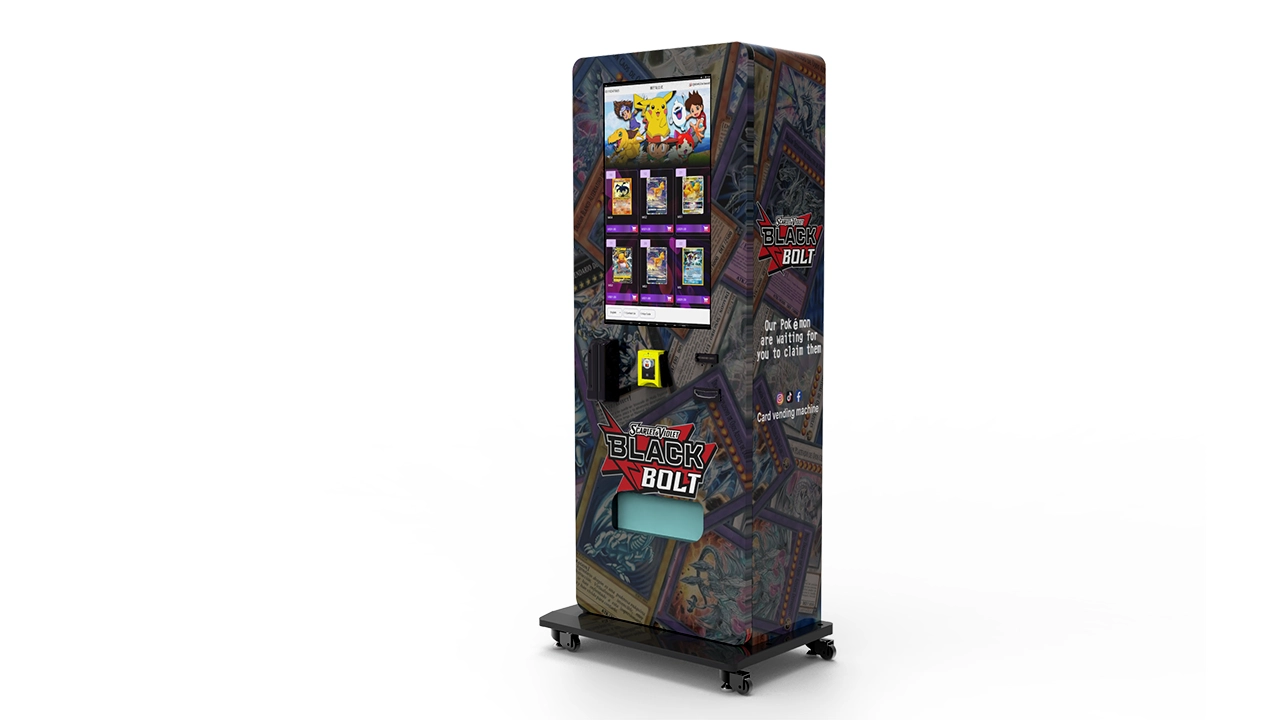
I learned this the hard way in 2021 when I placed a standard 32-inch touchscreen trading card vending machine in a high-traffic convenience store in a suburban area near Portland. The first month was spectacular, over $4,000 in sales. The second month, I walked in to find the glass shattered and the locking mechanism pried open. The store owner was apologetic, but the insurance claim took six weeks, and I lost nearly $2,000 in inventory. That incident taught me a permanent lesson: this is not a passive income stream. It is a high-value automated retail operation that requires the same security mindset as a jewelry display case.
The Unit Economics That Matter
Let me break down the numbers from my actual routes. A mid-range trading card vending machine with a 32-inch touchscreen, card dispensing mechanism, and secure cashless payment system costs between $6,000 and $12,000 delivered. The higher-end models with inventory tracking and remote monitoring push closer to $15,000. I have seen cheaper units for around $4,000, but they are usually wall-mounted card vending machines with limited capacity, and they break down more often. In my experience, the repair costs on a cheap machine will eat any savings within the first year.
On the revenue side, a well-placed machine in a convenience store with steady foot traffic of 500 to 800 people per day will generate between $1,800 and $3,500 per month in card sales. The gross margin on trading cards is typically 40% to 55%, depending on whether you are selling sealed packs or single cards. That means your gross profit per machine is roughly $800 to $1,900 per month before you account for restocking labor, credit card processing fees, and occasional maintenance.
Realistic Cost Breakdown and Return on Investment
I want to be direct with you about the payback period because I see too many articles promising a four-month ROI. That is fantasy. In my experience, the realistic return on investment for a trading card vending machine in a convenience store is between 10 and 18 months, assuming you do not make catastrophic mistakes. The machine cost is only half the picture. You also need to budget for initial inventory, which for a decent selection of Pokémon, sports cards, and a few specialty lines will run you $3,000 to $5,000. Then there is the payment system setup, which costs about $300 to $500 for a merchant account and card reader integration.
Here is a cost breakdown based on my last three installations:
| Expense Item | Low-End Estimate | High-End Estimate | Notes from My Routes |
|---|---|---|---|
| Machine purchase (new, mid-range) | $6,000 | $12,000 | 32-inch touchscreen with card dispensing |
| Initial inventory | $3,000 | $5,000 | Mixed sealed packs and single cards |
| Shipping and installation | $400 | $800 | Depends on distance and location |
| Payment system setup | $300 | $500 | Merchant account and card reader |
| Monthly maintenance reserve | $50 | $150 | For repairs and parts |
| Monthly credit card fees | 2.9% + $0.30 per transaction | Same | Negotiate with your processor |
That initial investment of roughly $10,000 to $18,000 is not trivial. I have seen operators try to cut corners by buying used equipment, and I will address that later because it is a trap that costs more than it saves.
Why Location Is 80 Percent of the Equation
I cannot overstate this: the machine itself is only 20 percent of the battle. The location determines everything. A trading card vending machine placed in a convenience store near a middle school or high school will outperform the same machine in a store that serves mostly an older commuter crowd. I have one machine in a small store near a high school that does $3,200 a month consistently. I have another machine in a larger store with better foot traffic but a demographic that skews over 50, and it struggles to hit $1,000 a month.
When I evaluate a potential location, I look for three things. First, the presence of young people aged 10 to 25 in the surrounding area. Second, the store's existing foot traffic patterns, not just total customer counts. Third, the store owner's attitude toward the machine. If the owner expects me to handle everything and shows zero interest in promoting the machine, I walk away. The best performing locations in my network have store owners who point customers to the machine and even mention new inventory on their social media. That organic promotion is worth more than any signage I could install.
Choosing the Right Machine Configuration
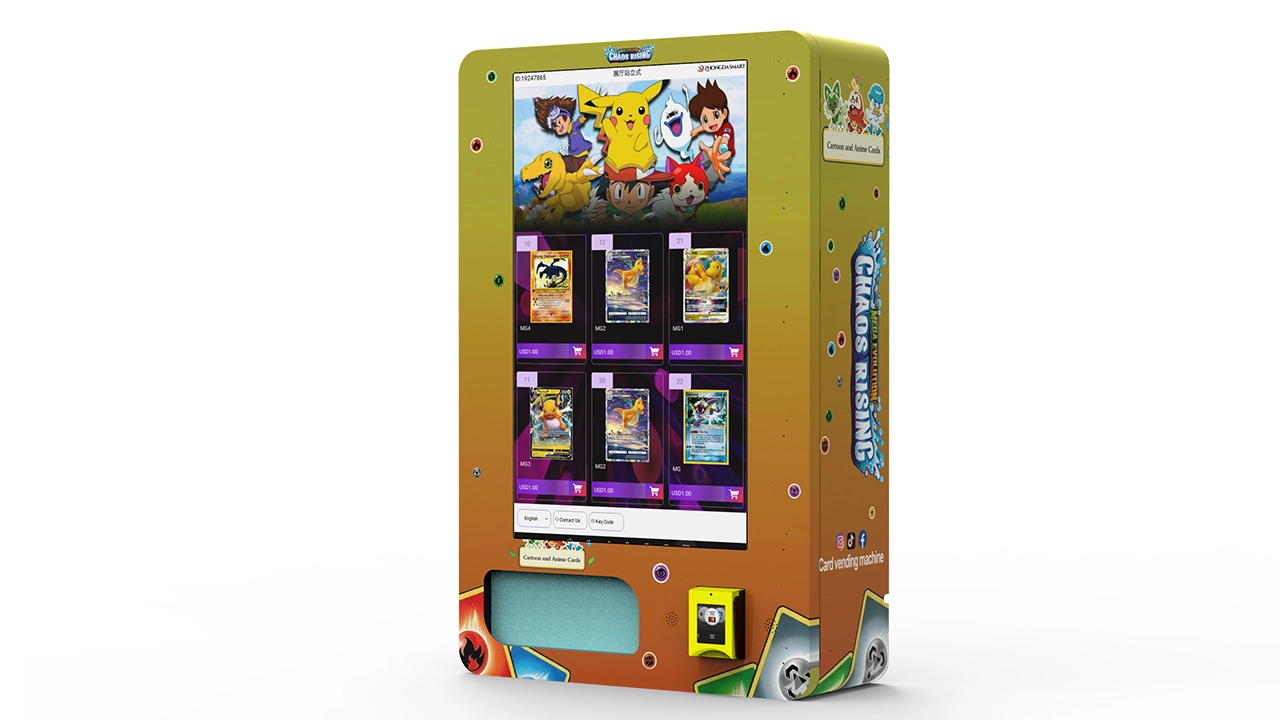
There are two main form factors you will encounter in the market. The freestanding 32-inch touchscreen model is the workhorse of the industry. It holds a large inventory, supports multiple card categories, and the screen can display pricing and promotional content. The wall-mounted card vending machine is a smaller unit designed for tight spaces. It holds less inventory, but it takes up virtually no floor space, which makes it attractive to convenience store owners who are hesitant to give up a footprint.
In my experience, the wall-mounted units are better suited for secondary locations or for testing a new market without committing to a large footprint. But they have a significant drawback: limited capacity means you restock more frequently, and if you are driving 45 minutes to restock a small machine, the labor cost eats your margin. I have a wall-mounted unit in a small tobacco shop that works well because I pass by it twice a week anyway. I would never put one in a location that requires a dedicated trip.
When you are looking at equipment, pay close attention to the card dispensing mechanism. This is the part that fails most often. I have tested machines from several manufacturers, and the quality of the dispensing wheels and the firmware that controls them varies widely. A jammed card is not just a lost sale; it is a frustrated customer and a service call. I currently run machines from Zhongda Smart on two of my routes, and their dispensing mechanism has been reliable compared to cheaper alternatives I tried earlier in my career. I am not saying they are the only option, but I have learned to prioritize mechanical reliability over fancy screen features.
Payment Systems and the Cashless Reality
If you are still thinking about a machine that only accepts coins and bills, you are making a mistake. The trading card demographic, kids and young adults, rarely carries cash. I would estimate that 85% of my transactions are cashless, either credit card or mobile wallet. A machine without a modern payment system is effectively invisible to your most lucrative customer segment.
I recommend machines that support multiple payment methods, including contactless cards, Apple Pay, Google Pay, and QR code payments. The integration of the payment system with the inventory tracking software is also important. I want to know in real time which products are selling and which are sitting idle. This data lets me adjust pricing and inventory without physically inspecting the machine. The upfront cost of a better payment system is negligible compared to the operational insight it provides.
Product Mix and Inventory Management
What you put inside the machine matters as much as where the machine sits. The trading card market is not a monolith. Pokémon is the dominant driver for the younger demographic, while sports cards, particularly football and basketball, attract an older collector base. In my experience, a balanced mix for a convenience store location is roughly 50% Pokémon, 30% sports, and 20% specialty or trending items.
I have made the mistake of overloading a machine with a hot product that I thought would sell forever. In late 2022, I stocked up heavily on a particular Pokémon set that was trending. The market cooled faster than I expected, and I was stuck with $1,800 of inventory that moved at a snail's pace. I eventually had to discount it heavily just to clear the space. The lesson is simple: do not fall in love with a product trend. Let the sales data guide your restocking decisions, and be willing to rotate products quickly.
Restocking frequency depends on volume, but for a convenience store machine doing $2,000 to $3,000 a month, I plan for a full restock every 10 to 14 days. That schedule also gives me a chance to inspect the machine for wear and tear, clean the screen, and check the internal temperature if the unit has any cooling components. A consistent maintenance routine is what prevents the small issues from becoming expensive vending machine repair calls.
Security and Theft Prevention
I touched on this earlier, but I want to give you a concrete picture of the security challenges. Trading cards are small, high-value items, and they are easy to resell. That makes them a prime target for thieves. In the Portland incident I mentioned, the thieves knew exactly what they were doing. They hit the machine at 3 AM, used a crowbar on the glass, and were gone in under two minutes. The store's security camera caught the whole thing, but the footage did not help recover the inventory.
Since then, I have implemented a few security measures that have significantly reduced incidents. I always anchor the machine to the floor or wall with heavy-duty bolts. I choose machines with laminated or polycarbonate glass rather than standard tempered glass. I also set up remote alerts that notify me if the machine door is opened or if the machine is tilted or shaken. Most importantly, I have a written agreement with the store owner that clearly states their responsibility for on-site security and my responsibility for the machine itself. That clarity prevents disputes when something goes wrong.
Self-Operated vs. Lease vs. Revenue Share Models
There is more than one way to structure your arrangement with a convenience store. The three common models are self-operated, lease, and revenue share. Each has its trade-offs, and I have used all three depending on the situation.
| Model | Upfront Cost | Monthly Commitment | Control | Best For |
|---|---|---|---|---|
| Self-operated | High (machine + inventory) | None to store owner | Full control over product and pricing | Operators with existing routes |
| Lease to store | Low for store owner | Fixed monthly rent | Store owner handles restocking | Store owners who want passive income |
| Revenue share | Moderate | Percentage of sales to store owner | Shared responsibility | Testing a new location with less risk |
For a convenience store owner who does not want to deal with the operational headaches, the lease model is attractive. You pay a monthly fee to a vending operator, and they handle everything. The downside is that your profit per machine is capped. In my experience, a lease arrangement for a trading card machine runs between $150 and $300 per month, depending on the machine value and the expected sales volume. That is a decent return if you are not doing any work, but it is a fraction of what you could earn by operating the machine yourself.
The revenue share model is a middle ground. I have used this when I was unsure about a location's potential. The store owner gets 15% to 20% of net sales, which gives them an incentive to promote the machine. The downside is that you still bear the restocking and maintenance costs, and if sales are slow, the store owner is not going to lose sleep over it. I recommend revenue share only for locations you are testing for a three-month period, with a clear clause that lets you convert to a fixed lease or remove the machine if it underperforms.
Regulatory and Compliance Considerations
Do not overlook the legal side of operating a vending machine in a commercial setting. In the United States, you generally need a sales tax permit, and you must collect and remit sales tax on each transaction. The rate varies by state and even by city, so you need to understand the rules for your specific location. In the European Union, the situation is different. If you are operating in an EU country, you need to comply with local VAT regulations, and the machine must meet CE marking requirements for electrical safety and electromagnetic compatibility.
I also recommend checking whether your business needs a specific vending machine license. In most US states, a general business license and a sales tax permit are sufficient, but some municipalities have additional requirements. The U.S. Small Business Administration provides a helpful overview of the licensing requirements by state, and I always check their resources before expanding into a new area. It is a small administrative effort compared to the headache of a compliance violation.
Common Mistakes I See New Operators Make
I have been doing this long enough to recognize the patterns of failure. The most common mistake is buying a machine before securing a location. I have seen people purchase expensive equipment, then spend months trying to find a store that will accept it. By the time they find a spot, the machine has been sitting in their garage, and they are already losing money. My advice is to secure the location first, even if it is just a handshake agreement, before you commit to a machine purchase.
The second mistake is underestimating the importance of inventory management. Trading cards are not like snack food. The market is volatile, and a product that is hot today can be cold in six weeks. New operators often buy too much of one product because they get a good deal from a distributor, only to find themselves stuck with dead inventory. I recommend starting with a smaller, diverse inventory and scaling up only after you see what actually sells in your specific location.
The third mistake is ignoring the data. Every modern trading card vending machine generates sales reports. If you are not reviewing those reports weekly, you are flying blind. I check my remote dashboard every morning, and I make pricing adjustments at least once a week. That discipline is the difference between a machine that consistently performs and one that slowly declines as the market shifts.
When to Walk Away from a Location
Not every convenience store is a good fit, and I have learned to walk away from deals that look good on paper but are problematic in practice. I once had a store owner who was enthusiastic about the machine but insisted on placing it in the back corner near the restrooms. I knew that location was terrible, but I agreed because I wanted the deal. The machine never did more than $600 a month, and I eventually moved it to a different store where it now does $2,500 a month. The lesson is that you cannot let the store owner dictate placement if they do not understand the business. You need to be the expert.
I also avoid locations where the store owner is clearly in financial distress. If a convenience store is struggling to keep its shelves stocked, it is not going to be a good partner for a high-value vending machine. The risk of theft increases, and the owner may not have the resources to maintain a secure environment. I have turned down at least five locations in the past two years for this reason, and I have not regretted any of those decisions.
Maintenance and Repair Realities
Every machine will break down eventually. The question is how prepared you are to handle it. I carry a basic toolkit in my vehicle, including spare dispensing wheels, a multimeter, and replacement locks. I have learned to troubleshoot common issues like card jams and payment system connectivity problems. For more serious issues, I have a relationship with a local vending machine repair technician who charges $75 per hour plus parts. In a typical year, I budget about $500 to $800 per machine for maintenance and repairs, but that number can spike if you buy a cheap unit.
I want to be clear about one thing: you cannot expect the convenience store owner to fix the machine. They are not trained, and they do not care about your equipment as much as you do. If you are not prepared to handle maintenance yourself or pay a professional, this business is not for you. The self-service kiosk model is attractive because it reduces labor, but it does not eliminate maintenance entirely.
Data and Market Context
To put this in perspective, the global vending machine market was valued at approximately $28 billion in 2023, and it is projected to grow at a compound annual growth rate of around 7% through 2030, according to Statista. The trading card segment is a small but fast-growing niche within that market, driven by the surge in collectible card popularity. IBISWorld reports that the retail sale of trading cards in the US has grown significantly over the past five years, although the growth rate has moderated from the peak pandemic levels.
These numbers are useful for understanding the macro trend, but they do not tell you whether a specific convenience store will be profitable. That depends entirely on local factors. I have seen machines in the same city, in stores that are five miles apart, with a threefold difference in monthly revenue. The data helps you understand the market direction, but your own operational data is what you should trust for decisions.
Expanding Beyond a Single Machine
Once you have one machine running smoothly, the natural question is whether to scale. In my experience, scaling is where the real money is made, but it also multiplies your operational complexity. I currently run a small fleet of 14 machines across two states, and I have a part-time employee who handles restocking and basic maintenance. That employee costs me about $1,200 per month, but he frees up my time to focus on location scouting and inventory management.
If you are thinking about scaling, I recommend getting one machine profitable first. Do not try to build a fleet before you have proven the model in your local market. The mistakes you make on the first machine are valuable lessons that will save you thousands when you expand. I made the mistake of scaling too fast in 2020, and I ended up with three underperforming machines that I had to sell at a loss. It took me a year to recover from that error.
FAQ
Are trading card vending machines profitable?
They can be, but profitability depends heavily on location and product mix. In my experience, a well-placed machine in a convenience store can generate $1,800 to $3,500 per month in sales with a 40% to 55% gross margin. However, a poorly placed machine can lose money. You need to evaluate each location on its own merits.
How much does a trading card vending machine cost?
A new mid-range machine with a 32-inch touchscreen and card dispensing mechanism costs between $6,000 and $12,000. Wall-mounted units are cheaper, starting around $4,000, but they have limited capacity and may require more frequent restocking. Budget at least $3,000 to $5,000 for initial inventory.
How long does it take to recoup the investment?
Based on my routes, the realistic payback period is 10 to 18 months, assuming the machine is in a good location and you manage inventory effectively. If you buy a used machine or place it in a marginal location, the payback period will be longer.
Should a beginner buy or lease a machine?
If you have no experience with vending machines, I recommend starting with a lease arrangement or a revenue share model to reduce your upfront risk. Once you understand the operational demands and have proven a location, you can transition to owning your own equipment.
Where should I place the machine for the best results?
Look for convenience stores near schools, sports complexes, or residential areas with a high concentration of young people. The store's existing foot traffic matters, but the demographic profile of that traffic is more important. A store near a high school is often a strong candidate.
What permits or licenses do I need?
In the US, you typically need a general business license and a sales tax permit. Some cities have additional vending machine regulations, so check with your local government. In the EU, you must comply with VAT registration and CE marking requirements for the machine itself.
How do I choose a reliable supplier?
Look for a manufacturer with a track record of reliable dispensing mechanisms and responsive customer support. I have had good results with Zhongda Smart on my routes, but you should also check independent reviews and ask for references from other operators. Avoid suppliers that cannot provide a local service network.
What happens if the machine breaks down?
You are responsible for maintenance and repairs. I recommend learning basic troubleshooting for common issues like card jams and payment system errors. For more serious problems, budget for a professional vending machine repair service. Do not expect the store owner to handle repairs.
How can I reduce restocking and maintenance costs?
Use a machine with remote inventory tracking so you only visit when restocking is actually needed. Plan restocking routes efficiently if you have multiple machines. Invest in a reliable machine to minimize breakdowns, and perform regular preventive maintenance to catch small issues before they become expensive repairs.
Disclaimer: The figures and timelines shared in this article are based on my personal operating experience and should not be interpreted as guaranteed financial outcomes. Actual results vary based on location, market conditions, foot traffic, product selection, and operational efficiency. Public market data referenced from Statista and IBISWorld is accurate as of the time of writing but is subject to change. Always conduct your own due diligence and consult with a financial or legal professional before making business decisions.